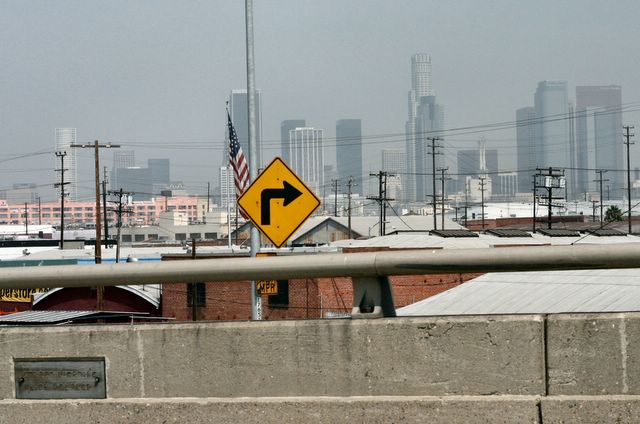
She must be crazy, I think, as I pass her by in my car, my silvery, rolled-up-window car, with the heater hot and airy and the music loud enough to drown out sirens and the back and forth swish of windshield wipers. Her powdered-white face despite brown arms, neck and legs, and a short satin skirt in the rain make no sense, umbrella or no. Trudging up the steep street in tall shoes guarantees a spill. She has to be crazy. I wait at a stop light and she stands on the corner, her face blank, unblinking, as she stares at me through the misty window. Why does she wear such thick and unyielding white makeup, red lipstick a prickled pear fallen in a snowy desert? She’d look like a geisha in another time, with more care, with grace and silk and cultural intention. I press the gas, and zoom away. She stares at me still with her masked face as she crosses on the yellow, disappearing from my view.
She must be crazy, a mental patient wandering, I think, as I scream songs within the car’s walls and worry about my gas mileage, driving past the newspaper fronts showing death in desert markets as innocents buy food and toothpaste and nod to their neighbors before blowing sky high.
Showing posts with label Fiction. Show all posts
Showing posts with label Fiction. Show all posts
Sunday, October 08, 2006

Sunday, August 27, 2006
Poetry-Fiction from 2002: Illicit - part 1
Soccer season is back on for the children. They've been doing it a long while, each year at a local church league that I like because it's less pressure. The children can either excel or chase butterflies and either way, they'll get hints on how to improve and a trophy at the end of the season. The place swarms with smiling parents and red-faced girls and boys, the place oozes a perfect cover, leaving me to wonder about underlying secrets. This series of poetic efforts came out of a single moment of observation of a man and woman, unrelated, giving each other a subtle glance before blending into the sea of flawless families.
***
"Snack Bar"
Chocolate donuts, sprinkled, glazed,
Black coffee, creamer, sugar,
Pretzel twists in a bag.
Fifty cents in my sweaty palm,
As I see you.
Goatee, salt and peppered,
Hazel eyes looking directly at me,
You make me blush.
"Large coffee," your voice hits me,
A kick of the ball to the chest.
Wedding ring glimmers
In a ten o'clock sun.
Gold shoved into the pocket of my jeans,
Hidden like another bit of lint.
"Anything else?" I ask.
I know what I want.
You say nothing at first,
Shaking your head and grinning knowingly.
"A goal for the team would be good," you say at last.
"One for the team. Here's change."
You walk away.
Stop an errant soccer ball,
Throw it back in play.
*****
"Ladies Room"
Trembling hands, eager mouths, wetness.
An empty coke can rolls along the floor.
A break in the game,
Sounded by a whistle.
"I gotta get back," I pant.
Sticky skin rubs against mine.
I gasp - we gasp,
As I'm pinned against the wall.
"Stay to left! Go, go, go!!"
Water from a leaky pipe puddles beneath us,
We splash unconsciously.
"Goalie! Get it, get it, get it! YES!"
Slick fingers pressed into my mouth,
I taste myself.
The door ... someone's at the door.
Hurry now, hurry.
*****
"Aztecs versus Fusion"
Squinting, I watch the swarm
Zig-zag between guarded nets.
The ball leads, pushes, pulls,
My eyes tire at the work.
Squeals, hoots,
Hollers, chuckles,
Clapping enthusiasm,
Such blind sweet love.
Metal bleachers absorb the sun,
Too hot beneath me.
Lemonade-filled cup sweats beads of icy water,
not enough to cool me as I rub it across my cheek.
One goal, two. A tie.
The hour nears its close.
You lean forward,
An excuse to touch.
I don’t know your name,
I like the anonymity.
I hope to keep it that way.
I know it won’t last.
The heat is endless, isn’t it?
***
"Snack Bar"
Chocolate donuts, sprinkled, glazed,
Black coffee, creamer, sugar,
Pretzel twists in a bag.
Fifty cents in my sweaty palm,
As I see you.
Goatee, salt and peppered,
Hazel eyes looking directly at me,
You make me blush.
"Large coffee," your voice hits me,
A kick of the ball to the chest.
Wedding ring glimmers
In a ten o'clock sun.
Gold shoved into the pocket of my jeans,
Hidden like another bit of lint.
"Anything else?" I ask.
I know what I want.
You say nothing at first,
Shaking your head and grinning knowingly.
"A goal for the team would be good," you say at last.
"One for the team. Here's change."
You walk away.
Stop an errant soccer ball,
Throw it back in play.
*****
"Ladies Room"
Trembling hands, eager mouths, wetness.
An empty coke can rolls along the floor.
A break in the game,
Sounded by a whistle.
"I gotta get back," I pant.
Sticky skin rubs against mine.
I gasp - we gasp,
As I'm pinned against the wall.
"Stay to left! Go, go, go!!"
Water from a leaky pipe puddles beneath us,
We splash unconsciously.
"Goalie! Get it, get it, get it! YES!"
Slick fingers pressed into my mouth,
I taste myself.
The door ... someone's at the door.
Hurry now, hurry.
*****
"Aztecs versus Fusion"
Squinting, I watch the swarm
Zig-zag between guarded nets.
The ball leads, pushes, pulls,
My eyes tire at the work.
Squeals, hoots,
Hollers, chuckles,
Clapping enthusiasm,
Such blind sweet love.
Metal bleachers absorb the sun,
Too hot beneath me.
Lemonade-filled cup sweats beads of icy water,
not enough to cool me as I rub it across my cheek.
One goal, two. A tie.
The hour nears its close.
You lean forward,
An excuse to touch.
I don’t know your name,
I like the anonymity.
I hope to keep it that way.
I know it won’t last.
The heat is endless, isn’t it?
Wednesday, August 02, 2006
A little horror-gothic Fiction for your day (from 2004): Waiting
She waited for me by the car – frazzled reddish hair to her shoulders, dark circles under ice-blue eyes, and magenta fuzzy slippers that had stepped into too many rain puddles. The expression on her face echoed the tearing away of patience. I shoved my hands deep into the pockets of my faded jeans, hunched my shoulders to burrow into my sweatshirt, and looked across the parking lot reflecting the edges of dawn. I walked in the mist, ready for the big kiss-off, knowing I wouldn’t get it.
This was maybe the twentieth time she picked me up from a Los Angeles County emergency room: a flare-up of one disorder or another…a busted hand from a fight…the occasional overdose. Tonight’s diagnosis: failure to take medication in a timely manner.
I shuffled along cracked asphalt, counting the steps.
“Sixty-five. Sixty-six. Sixty…sixty-eight…oh, double-step…”
She hadn’t changed positions since step number twenty-two. Not a shifting from her right leg to her left or an adjustment of her arm or anything.
Leaning up against the car door, she waited as if there were the smallest chance this would be the last time. Waited, as if something different were going to happen tomorrow, next week, the week after. I wondered if she did it out of love or masochism. Maybe we’re all masochists in love with ourselves, with suffering. Maybe there are millions standing by their cars…waiting.
I looked like shit after more-than-a-few hours on a gurney recovering from the effects of having missed days of one of my epilepsy meds. Oh hell, it was the one series of pills I thought I could skip. Gets tiring, day in and day out, to take so many. A cashier found me behind Von’s having grand mal seizures. I knew something bad was happening when the color of the world altered and I started smelling funny things. Last word I remember: oops.
After I called Jory, after having been poked and prodded and given a CAT scan, I lay on my side imagining the process of her leaving. She’d drag herself out of bed, throw on clothes, and grab the keys she hid in the microwave oven. She’d walk down the three flights of stairs of our apartment building, and start up the VW bug. We got a 1968 piece of crap that barely runs – probably only had a little gas. There’d have been mild cursing when she read the gauge.
I hated dialing home. You wouldn’t think so. Guilt lived with me the way a slug lives in a garden: for the most part it’s ignored, but most likely it’ll end up mush under a muddy boot. So…why hesitate?
Her voice had told me she wasn’t awake. ‘Course not – it was four a.m.
“’Lo?”
“Hey, babe…I’m at the hospital…pick me up?”
“Shit, not again. Time is it…Jesus.”
She paused and had me hanging by my fingernails on a plank of hope…and worry. I could practically see the locks of hair in her eyes, her big pink t-shirt with red balloons that said, “Love my balloons too hard and I’ll pop all over you.” Underneath, she wore grandma-style, matching pink panties. No bra. The get-up was her favorite sleeping gear. She’d gotten ready to tell me to go fuck myself. I heard the scrunching up of her mouth.
“Yeah, okay…I gotta bring cash?”
“Nah.”
Another sigh. “You all right?”
“Yeah.” She didn’t ask what happened, maybe out of relief that it wasn’t jail or the psych ward.
I reached the car in one hundred forty-three steps.
“Hey, beautiful,” I said, trying to sound normal, a chore for glitches in the norm. That's me, a glitch. I came into this life a “preemie” weighing ten pounds and measuring 23-inches…with a birthday six months from my parents’ wedding date. I grew up under the gaze of Nebraska Baptists who looked at me as if I were unfinished…a horrific miscalculation…sin itself. My parents probably felt the same way, going on to have more kids, each one a wonderful improvement on the last. In the end, they had one lawyer, one minister, a pediatrician, a veterinarian, and … someone they didn’t like to think about.
“Just get in,” Jory snapped. I slumped in the seat, fiddled with the heater. We drove in silence. Suddenly, she made a turn I wasn’t familiar with.
“What’s this?”
“Penance.”
She didn’t explain, keeping her eyes on the road. She wore an old, no-longer-white ski parka we’d picked up in a thrift shop last year. Blue fake fur lined the cap and the color reminded me of a movie McDonalds whored itself for a couple of years ago, something about monsters running a corporation. That was it – she looked like a blue, fuzzy monster turned inside out. Or maybe more like she skinned a blue monster and now wore his fur as a token of triumph. I swallowed hard, thankful to have at least kept up the bipolar meds. Glancing down, I read the stickers Jory put on the glove compartment: Free the Whales, Life’s a Bitch then You Die, Put Christ Back in Christmas, I Don’t Break for Pedestrians.
I have one bumper sticker, and I usually affix it figuratively to my ass: boo fucking hoo.
“Just tell me where we’re going.”
“Outta town.”
“What about work? Isn’t old Bob gonna miss you?” Jory was an executive assistant, a nice word for a secretary. She got paid all right – not enough. I was too disabled to work or drive or do anything. I looked at Jory, wondering again why she put up with me.
“It’s technically Saturday. I don’t work on weekends.”
“Oh.”
We finally got on a freeway, and I saw we were headed toward Palmdale, toward the Mojave Desert, a delightful monopoly of sand and dirt and plants nobody would want in their backyard. I mumbled about how I was going to straighten up. I’d be as clean and as organized as the miles of smooth emptiness we were traversing now. Low traffic and blacktop lit by morning accompanied my chattering. The putter of the bug’s engine gave me visions of a tow truck coming to our rescue.
She pulled off an exit, but I didn’t catch the name of the street. I tried, craning my neck to see. She drove slowly, looking around even though there wasn’t much of a vista. The sun started to warm me, so I shut the heater off.
“There it is,” she said softly, taking a sharp right onto an unpaved road. The car bumped and thumped and jumped, forcing Jory to shift into a lower gear.
“The hell?!”
“Shut up,” she hissed.
“Hey, baby, I’m gonna change, you know?” It was hard to believe I actually said such incredibly distasteful, not to mention cliché, words.
“I know that – I’m gonna change, too.”
“What you talkin’ about, Willis?” I watched a lot of “Nick at Nite.” That Willis line was from this one show about a white dad adopting a witty black boy and his older brother. The youngest kid, the witty one, was…really short. I guess the program spoke to a universal problem – deep inside, we’re all…really short.
“Shush.”
I did. I’d tried to clean up my act several times during our two-year relationship. Once I stayed in a rehab for two whole days. I didn’t like the food. She never overtly asked me to stop any of my doings. She ached over it, made faces at me of impatience, yet she never said, “Stop.”
She watched the road and slowed the car. Her closed lips stretched to the side in a satisfied grin, and she nodded while narrowing her eyes. We’d finally reached her destination: a large, abandoned, ranch-style house. The windows were busted, and once-decorative shutters hung like petrified flags that died on a windless day. The roof was flat with white and gray rocks scattered across the top, and the tan paint was peeling – a sunny day’s ruination. Tall, lanky stalks of dead yellow weeds emerged from an ocean of bulbous cactus.
Jory got out, stretched her arms, and said, “Isn’t this wonderful?”
“I don’t think so. Shouldn’t we get back?”
“No…this is your lucky day. Today is the first day of the rest of your life.”
I think that line was on our freezer door. I argued, “Isn’t every day the first day? I mean, if you think about it…”
She pounced on me, “You don’t understand. Last night’s foray was your last.” She walked over to a planter that looked like an old well and pulled out a long rope. “Did you know I won first place for calf-roping when I was twelve?”
I ran like hell…except she got to me and within seconds I was…well, roped. I couldn’t move, couldn’t breathe – I panicked. She put her knee somewhere up near my shoulder – she was resting. My cheek pressed into sand.
“Whooo-wee…you’re a tough one.”
“Jory…what’s the matter? What did I do different?”
“It’s not that it was different…it’s that it was the same. You almost had me fooled. Last time I had to pick you up from urgent care was over two months ago. I almost thought you turned a corner.”
“But it’s our joke, babe…you know…I’m a recidivist. I thought you liked that.”
“Yeah…I got into the codependence, I liked rescuing you…I liked that you felt better around me. All your hurts would seem to fade away when we were together. Your smile was precious because you rarely showed it to anyone.” She bent low and whispered hotly in my ear, “You made me feel so special.”
“You are special…”
“You got that right.”
She stood and got a hold of my fettered elbow. Dragged me across the lot toward the front door. Once at the entrance, she pulled me inside. My shirt slipped upwards and my heaving chest scraped along what used to be nice linoleum. Gold colors, yellows, mustards. A 1970’s house gone bad. Sliding along the no-longer-shimmering lines, I realized I was being sacrificed. I was a slug about to be squashed.
Finally, I came to a rest. Jory sat cross-legged several feet away. She was in the middle of what used to be a kitchen. The stove, the oven, the fixtures, the sink were gone – even the cabinet doors were gone. There used to be a counter for food preparation or for putting vases on or for papers to get ready for sorting…the top had been sheared off. I supposed Formica had value on the black market. I looked at the sliding glass doors. Someone had spray-painted in black on the right-hand side, Junipero was here.
“Do you remember where we met?” Jory hugged her knees and eyed me.
“Intersection of Grand and Ninth.”
“You were completely lost. Delusional. You asked me if I was from Mars...then you decided I was an angel because of the halo.”
“You are an angel!”
“I remember coming to see you at the psych ward after a week or so. You were so much better. We had coffee after you got out, and you wrote a poem to me. I cried. We walked hand-in-hand…and you smiled…and asked me for my number. I wrote it on a dollar bill, the only paper I had. You walked away backwards, wagging the money. You affected me.”
“We met for lots of food. Lunches, breakfasts, dinners.”
“Yes…we fed each other. We became a pair…we had heart. You moved in, you took care of the finances – you helped make my shack a home. Then the hospital visits started. One year to the date. Once you had me in your grip.”
“You’re saying I set you up?”
“It took some time for me to figure it out. You slowly moved into my life – first the dates, then the clothes being left, then you – followed by the draining.”
“But that’s how ALL relationships go!”
She had it wrong. I hadn’t set her up. I just got comfortable, I started to be myself, someone who just happened to indulge in my essential uselessness. I expounded on the trait – built it up to an art form.
She left. I called for her. I heard her re-enter the room. Her furred feet stopped at my head, one foot lifting and then landing on top of the other. The whole thing made me wonder how she did that without falling over, forcing me to look up. I saw she had a sledgehammer to lean on.
“This house,” she said, “is your brain – devoid of furnishings, fresh paint, and love – no class. Oh there’s potential, but the end result is the same. The walls still hold nothing.”
She lifted the hammer above her head and slammed it down to my right. My heart raced, I breathed the breaths of a runner at the end of a sprint, I sweated the sweat of a marathoner – I couldn’t talk. I wanted to beg for my life, I wanted to say I’d paid for all my wrongs.
She lifted the hammer again and crashed it against the floor causing a vibration behind my eyes. Liquid leaked like helium out of a balloon. I expected her to start talking in a high-pitch voice…because my head was as fragile as expanded latex…certainly helium kept me standing normally.
“You’re crying?”
Sniffling snorts answered her.
“You know, it would have been nice if even once you said, thank you.”
She lifted the hammer way above her head and the metal hunk landed near my ear. She moaned…almost ecstatically. She sauntered to the painted hearth and pulled on something. I soon saw thick, black hooks cemented into the mortared bricks.
The helium in my head started to pour out, through my nose, my mouth, my eyes. Liquid leaked into my jeans. Before long I’d be the remains of a kiddie party…red, popped latex…useless, used. I hiccupped in fear.
She dragged me across the floor in short, rough jerks. Pausing, she rubbed her chin with her hand then left again. I inched away from the looming, medieval hooks. Christ, how’d she do it? When? How’d she find the place? Sweet, angelic Jory…so delicate in the way she ate a bagel topped with cream cheese, biting down carefully to avoid a mess, licking the corners of her mouth. She had a strawberry tongue – round shapes would mark up the pink if she ate something that disagreed with her chemistry.
I was moving again, being dragged back into place. Another rope was wrapped around me. Suddenly, I was being lifted, heaved upwards. At last I was hanging, swaying. Jory worked some more ties until I could no longer move. I was cocooned in hemp rope and held in place by the hooks.
She explained, “Here you’ll stay, my dear, hopeless man. You’re now in a place where you can think on your deficiencies. You’ll be free to reflect on how you can better yourself – the many areas in which there might be room for improvement. In time, I’m sure you’ll feel remorse, gratefulness for the times I rescued you.”
Somewhere, I found my voice. “Jory, baby…I always appreciated the love you gave. Please, don’t do me this way. I’ll make it up to you!”
“I understand you can’t help the epilepsy…or that you’re bipolar. Your brain works against you. The system, our government, doesn’t help. They keep you disabled, remove your power. So many things are in your way.”
She smiled hugely, “However, I believe in you. I believe you can overcome. I believe in your strength as a person – as a man.”
I dribbled the remaining helium from my balloon of a soul, deflating. I thought maybe if I really became flat, I could fall out of the bindings. Such wasn’t the case. I’d be left…hanging on a string, leftovers from a party waiting to be trashed. I found myself wailing.
“Oh no. No, no, no. Don’t cry. What did you really have to look forward to? Sitting around our apartment watching TV, getting stoned on drugs, playing Russian Roulette with your medications, making fun of the neighbors?”
“That’s a kind of life!” I warbled.
She sighed. Picked up the sledge hammer and swung at the wall next to the brick hearth where I was, causing a shower of plaster from the ceiling. She danced around the room, smashing the other walls, whooping it up. As the haze from the dust cleared, I caught sight of something huddled in the skeleton of a cupboard. Ropes. Jeans. A red plaid, flannel shirt. They were very…sandy. I clapped my eyes on Jory.
“Jor…sweetie…you never told me what happened to your last boyfriend. You know, the Canadian paraplegic?”
She blinked. Smiled sadly. Shook her head.
“He was so ungrateful.”
The sun is now setting, and I’ve had no water, no food, no love or understanding. There’s no need to piss, because all the helium is gone. I’m deflated. The desert is a serene place. The house is far enough from the city so you can’t hear any evidence of civilization. Coyotes bark and howl their sad tales. Lizards scramble along the floor. The weeds and cactus plants are still and hum eternal tones.
I think of a future where I will wake up, take my meds, and dress. I’ll sit at our breakfast table with a bright yellow mug of coffee and eat a bowl of fortified cereal. Jory and I will chat about our love-making the night before, and we’ll dish the shocking political battle being reported on the radio. I’ll get up when we finish and help clean the kitchen. I’ll kiss her goodbye and whisper a “thank you.” I’ll walk to the stop where I’ll take the local to my next job. Or to an appointment with a counselor. Or to a place that will make me feel inflated…alive…valuable. I will thrive on my independence.
I picture these things. I think it’s possible…such a life. I’ll just have to wait for that time to come while I hang here, trussed.
Friday, June 09, 2006
Fiction: Relevance
The kids called him Suicide. There wasn’t a lot of imagination that went into the name. See, the minister’s son really did commit suicide. During the spring break of his high school senior year he lifted a 12-guage shotgun, aimed it at his chest, and pulled the trigger. The blast cut him in two and left a cascade of blood on the back porch of his parents’ Pasadena bungalow especially for them to find.
I remember him as Richard. He shuffled along the sides of filled hallways and ate peanut butter sandwiches alone on the bleachers with Star Trek novels for entertainment. Bad acne and a lanky build made for a tendency to trip over his size 13 feet. He always wore grey slacks and collared shirts. He must have owned ten sets of the same outfit because he never wavered from the uniform. Not good for self esteem in the early 80’s where preppy was significantly more…stylish. His father preached from a local Baptist pulpit before Christianity was cool.
Richard tried drama in the fall of his tenth grade year. Played Charlie Brown in “You’re a Good Man, Charlie Brown.” We all attended because the school play was a main social focus, ranked third in importance behind the Homecoming football game and the Senior Prom. The depressive Charlie Brown with the beaming smile fit him perfectly in spite of the bad skin. He moped around the stage and sang in key and towered over the rest of the cast. He was weird enough that I developed a fascination with him. I loved Peanuts cartoons, having discovered them in a Bluejay bookstore, near Big Bear, on vacation with my parents when I was in the third grade.
To me, he embodied Charlie Brown.
I was his ninth-grade Lucy.
Beginning the first Monday morning after the play, I followed him around campus as much as I could and recorded notes about him in my black-and-white composition notebook. “CB walked to the bathroom twice today. The jam in his sandwich looked red instead of purple. His shoes were scuffed. He sneezed so hard at lunch he blew snot all over his sweater. Today, he wore the blue sweater with the college emblem. His acne is worse than ever.” Months it went on. I had a hundred pages of notes.
One spring day he caught me staring at him during Mrs. Tolbert’s mixed doubles tennis. I was waiting for my turn to play, sitting on a bench with the notebook at my side. He came up to me and grabbed the notebook out of my hand. I was mortified.
“Who’s CB?” he demanded after flipping through some of the pages, white shorts and yellow t-shirt (representative of our school team, the Bumblebees) too tight on his skinny body. They had to be hand-me-downs.
“Nobody you know,” I said.
“You’re a freak. You know that, don’t you?”
“Pot…meet kettle.”
I sidled up to him, craning my neck to get a good look up his nostrils. He snorted like a bull and shoved the notebook against my bulbous chest, pushing me far back. I collapsed back on the bench, immediately pulling out my pen to write of the interaction.
Mrs. Tolbert screamed my name to get onto court three, causing me to jump. My words got jumbled. She yelled Richard’s name and much to our horror, we were made partners.
“You’ve gotta be kidding,” he muttered.
I thought his arrogance was amazing considering how bad he looked and how wrong a fit he was for our average, checker-board high school. He should be moping on stage, I thought. He should be at the performance arts high school where students learn to sing and dance and act instead of the usual stuff. Richard had talent. I wanted to tell him, but his affront prevented me from offering the compliment.
The tennis game went badly. I kept missing the ball, I couldn’t serve worth beans, and I kept crashing into my partner. He panted and cursed under his breath and finally at the end, threw his tennis racket across the court, the racket skipping and sliding along the black tar. At the top of his lungs, he belted, “You’re an idiot!”
He stormed off to the boys’ lockers.
Appalled, I marched across the court and grabbed my notebook, sitting on the bench and writing, “Mrs. Tolbert is an evil servant of Satan. She paired me with CB and I discovered that he has a bad temper. She should have helped keep that trait hidden. The real CB gets frustrated but never throws rackets.”
Three days in a row we had to play together due to the racket-throwing incident. I never improved but we did get into a groove. I would simply step aside while he hit the ball the entire time. We won most of the matches that way. He didn’t speak to me the rest of the week.
I thought I’d never interact with Richard again. I’d accepted that. I was satisfied to resume my observations of him. Unfortunately, Mrs. Tolbert thought we made such a good pair at mixed doubles that she continued to pair us throughout the following week. After a particularly exhausting match in which I had to sidestep more than fifty lobs in typical Pasadena ninety-degree, smoggy heat, I offered to get him a cold soda from the school canteen.
“You paying for it?”
“If you don’t have any money.”
Shrugging a shoulder after a moment or two, he agreed. “I don’t have any money,” he said.
When I returned, he took the generic coca cola with a huffy attitude. I attributed it to the soaring temperature.
“What’s it like being a minister’s son?”
He looked sideways at me, asking, “What’s it like being a freak?”
I got brave, thinking he needed my sympathy, thinking I was being a good person to befriend the friendless. “You were really good in Charlie Brown. You should think about doing community theater.”
He snarled, “I’d rather slit my throat.”
In complete shock, I plopped down on the bench next to him. “What do you mean? You were in your element up there on stage. Your singing was the singing of angels, you were sublime. You’ve got more talent in your little toe than any of those other hacks on stage with you.”
He looked at me sideways, letting out a slow tongue-against-teeth whistle. “I’m your CB. You’re following me around.”
Grinning, I purred, “You are Charlie Brown incarnate. I am Lucy.”
He sucked down the soda and threw the can in the trash. He stood up, all six foot two of him. “Being a minister’s son,” he said, “is much like being a freak. We have our missions that have been handed down to us from a place that only exists based on faith. We have purpose that’s greater than we are. We venture into the great beyond, passing the word to our fellow man from on high. We are…relevant.”
“Oh yessss,” I murmured, my blood on fire, my limbs spaghetti. I was in love. I was in heat.
He stepped back at the raging furnace of my being and turned around to head to the lockers. I called after him and he put up his hand to shut me up. I dug through the trash and collected the soda can he’d drunk from. I breathed in the air from the empty hull that only moments before had been filled with cola nectar touched by his saliva. I ran my tongue up and down the sides of the can, willing to risk a slicing just to taste the sweat from his hands. Hoofing it to the bathroom, I locked myself in a bathroom stall so I could strip down and touch my body until I was exploding in orgasmic energy, slamming down onto the toilet to regain my footing.
I wanted to be with him, I wanted to be inside of him so I could course through his veins and slide through his heart and swish around in his belly like Jonah and the whale.
The next day he scuffled away from me when I reached for his hand during the passing period.
I wrote in a fever, “CB is running away from his love of me. He wears a purple sweater with a monogram that reads RS. He has new shoes. The Star Trek novel is stuck in his back pocket, pressing up against his ass. He threw away his sandwich in the trash and I ate it. Bologna. Very different from peanut butter. Strife perhaps has hit his home.”
The semester ended without getting so much as one word from Richard. I snuck into his church one Sunday to see him sing in the choir. He opened his mouth and pure heaven came from the depths of his soul. Being Jewish, I wasn’t familiar with any of the hymns. As he sang, I felt every cell of my body come alive. I got on my knees and put my hands in the air, grateful for every note that hit me. When the singing was over, he saw me and grinned. Mouthed the words, “We are relevant.”
The entire next year I spent in a psychiatric hospital for delusions, I was told. They did not understand love. They misinterpreted the slashing of my wrists for suicide. What they did not realize was that I was sending a love-gram to Richard – I was spilling my blood a la Christ, admittedly an over-the-top, dramatic display of my devotion. They took my notebooks. My parents were told that I had developed an unhealthy fascination for the fictional character, Charlie Brown.
When I returned to campus for my junior year, I learned that Richard had gone to a private school. When I learned that he’d committed suicide following spring break, I wore a hooded sweatshirt in mourning. I wrote in my notebooks. I spoke to nobody and refused to do homework for one week. I ate nothing but peanut butter sandwiches sloshed with grape jelly and layered with bologna.
When my English teacher asked me to write an expository essay on the definition of symbolism, I wrote over and over and over, “We are relevant.”
I remember him as Richard. He shuffled along the sides of filled hallways and ate peanut butter sandwiches alone on the bleachers with Star Trek novels for entertainment. Bad acne and a lanky build made for a tendency to trip over his size 13 feet. He always wore grey slacks and collared shirts. He must have owned ten sets of the same outfit because he never wavered from the uniform. Not good for self esteem in the early 80’s where preppy was significantly more…stylish. His father preached from a local Baptist pulpit before Christianity was cool.
Richard tried drama in the fall of his tenth grade year. Played Charlie Brown in “You’re a Good Man, Charlie Brown.” We all attended because the school play was a main social focus, ranked third in importance behind the Homecoming football game and the Senior Prom. The depressive Charlie Brown with the beaming smile fit him perfectly in spite of the bad skin. He moped around the stage and sang in key and towered over the rest of the cast. He was weird enough that I developed a fascination with him. I loved Peanuts cartoons, having discovered them in a Bluejay bookstore, near Big Bear, on vacation with my parents when I was in the third grade.
To me, he embodied Charlie Brown.
I was his ninth-grade Lucy.
Beginning the first Monday morning after the play, I followed him around campus as much as I could and recorded notes about him in my black-and-white composition notebook. “CB walked to the bathroom twice today. The jam in his sandwich looked red instead of purple. His shoes were scuffed. He sneezed so hard at lunch he blew snot all over his sweater. Today, he wore the blue sweater with the college emblem. His acne is worse than ever.” Months it went on. I had a hundred pages of notes.
One spring day he caught me staring at him during Mrs. Tolbert’s mixed doubles tennis. I was waiting for my turn to play, sitting on a bench with the notebook at my side. He came up to me and grabbed the notebook out of my hand. I was mortified.
“Who’s CB?” he demanded after flipping through some of the pages, white shorts and yellow t-shirt (representative of our school team, the Bumblebees) too tight on his skinny body. They had to be hand-me-downs.
“Nobody you know,” I said.
“You’re a freak. You know that, don’t you?”
“Pot…meet kettle.”
I sidled up to him, craning my neck to get a good look up his nostrils. He snorted like a bull and shoved the notebook against my bulbous chest, pushing me far back. I collapsed back on the bench, immediately pulling out my pen to write of the interaction.
Mrs. Tolbert screamed my name to get onto court three, causing me to jump. My words got jumbled. She yelled Richard’s name and much to our horror, we were made partners.
“You’ve gotta be kidding,” he muttered.
I thought his arrogance was amazing considering how bad he looked and how wrong a fit he was for our average, checker-board high school. He should be moping on stage, I thought. He should be at the performance arts high school where students learn to sing and dance and act instead of the usual stuff. Richard had talent. I wanted to tell him, but his affront prevented me from offering the compliment.
The tennis game went badly. I kept missing the ball, I couldn’t serve worth beans, and I kept crashing into my partner. He panted and cursed under his breath and finally at the end, threw his tennis racket across the court, the racket skipping and sliding along the black tar. At the top of his lungs, he belted, “You’re an idiot!”
He stormed off to the boys’ lockers.
Appalled, I marched across the court and grabbed my notebook, sitting on the bench and writing, “Mrs. Tolbert is an evil servant of Satan. She paired me with CB and I discovered that he has a bad temper. She should have helped keep that trait hidden. The real CB gets frustrated but never throws rackets.”
Three days in a row we had to play together due to the racket-throwing incident. I never improved but we did get into a groove. I would simply step aside while he hit the ball the entire time. We won most of the matches that way. He didn’t speak to me the rest of the week.
I thought I’d never interact with Richard again. I’d accepted that. I was satisfied to resume my observations of him. Unfortunately, Mrs. Tolbert thought we made such a good pair at mixed doubles that she continued to pair us throughout the following week. After a particularly exhausting match in which I had to sidestep more than fifty lobs in typical Pasadena ninety-degree, smoggy heat, I offered to get him a cold soda from the school canteen.
“You paying for it?”
“If you don’t have any money.”
Shrugging a shoulder after a moment or two, he agreed. “I don’t have any money,” he said.
When I returned, he took the generic coca cola with a huffy attitude. I attributed it to the soaring temperature.
“What’s it like being a minister’s son?”
He looked sideways at me, asking, “What’s it like being a freak?”
I got brave, thinking he needed my sympathy, thinking I was being a good person to befriend the friendless. “You were really good in Charlie Brown. You should think about doing community theater.”
He snarled, “I’d rather slit my throat.”
In complete shock, I plopped down on the bench next to him. “What do you mean? You were in your element up there on stage. Your singing was the singing of angels, you were sublime. You’ve got more talent in your little toe than any of those other hacks on stage with you.”
He looked at me sideways, letting out a slow tongue-against-teeth whistle. “I’m your CB. You’re following me around.”
Grinning, I purred, “You are Charlie Brown incarnate. I am Lucy.”
He sucked down the soda and threw the can in the trash. He stood up, all six foot two of him. “Being a minister’s son,” he said, “is much like being a freak. We have our missions that have been handed down to us from a place that only exists based on faith. We have purpose that’s greater than we are. We venture into the great beyond, passing the word to our fellow man from on high. We are…relevant.”
“Oh yessss,” I murmured, my blood on fire, my limbs spaghetti. I was in love. I was in heat.
He stepped back at the raging furnace of my being and turned around to head to the lockers. I called after him and he put up his hand to shut me up. I dug through the trash and collected the soda can he’d drunk from. I breathed in the air from the empty hull that only moments before had been filled with cola nectar touched by his saliva. I ran my tongue up and down the sides of the can, willing to risk a slicing just to taste the sweat from his hands. Hoofing it to the bathroom, I locked myself in a bathroom stall so I could strip down and touch my body until I was exploding in orgasmic energy, slamming down onto the toilet to regain my footing.
I wanted to be with him, I wanted to be inside of him so I could course through his veins and slide through his heart and swish around in his belly like Jonah and the whale.
The next day he scuffled away from me when I reached for his hand during the passing period.
I wrote in a fever, “CB is running away from his love of me. He wears a purple sweater with a monogram that reads RS. He has new shoes. The Star Trek novel is stuck in his back pocket, pressing up against his ass. He threw away his sandwich in the trash and I ate it. Bologna. Very different from peanut butter. Strife perhaps has hit his home.”
The semester ended without getting so much as one word from Richard. I snuck into his church one Sunday to see him sing in the choir. He opened his mouth and pure heaven came from the depths of his soul. Being Jewish, I wasn’t familiar with any of the hymns. As he sang, I felt every cell of my body come alive. I got on my knees and put my hands in the air, grateful for every note that hit me. When the singing was over, he saw me and grinned. Mouthed the words, “We are relevant.”
The entire next year I spent in a psychiatric hospital for delusions, I was told. They did not understand love. They misinterpreted the slashing of my wrists for suicide. What they did not realize was that I was sending a love-gram to Richard – I was spilling my blood a la Christ, admittedly an over-the-top, dramatic display of my devotion. They took my notebooks. My parents were told that I had developed an unhealthy fascination for the fictional character, Charlie Brown.
When I returned to campus for my junior year, I learned that Richard had gone to a private school. When I learned that he’d committed suicide following spring break, I wore a hooded sweatshirt in mourning. I wrote in my notebooks. I spoke to nobody and refused to do homework for one week. I ate nothing but peanut butter sandwiches sloshed with grape jelly and layered with bologna.
When my English teacher asked me to write an expository essay on the definition of symbolism, I wrote over and over and over, “We are relevant.”
Friday, April 14, 2006
Fiction: Pasadena Freeway
She gripped the door handle of their twelve-year-old Jaguar when she saw the red lights of slowing cars at this midnight hour. A squeak slipped from her throat as she pressed a sandaled foot on the floorboard and he grumbled, “I see them, I see them.”
“But I always see them first.”
The Pasadena Freeway’s hairpin turns were treacherous. Stopped cars sometimes appeared to come out of nowhere, the sharp curves preventing a driver from seeing the wall of red before it was too late. A driver had to be firm on toes, anticipate the dangerous spots.
The play at the Dorothy Chandler Pavilion in downtown, L.A., ended surprisingly late. The show had been enjoyable, a comedy of errors made even better because the tickets were given to them by her husband’s coworker in the bank’s real estate department. Traffic was surprisingly heavy even for a Saturday night. She’d been sweating when he honked the horn going through the Figueroa Tunnels, afraid of the cars to her left and right. The lanes were narrower than on most Southern California freeways because there was no room for expansion.
Putting her fingers on the cold glass, she craned her neck to see the old houses at Heritage Square. For years she passed by on her way to school and never learned the exit to get to the park. The insides of the Victorian houses culled from decaying Los Angeles neighborhoods were left to her imagination. There was a new one there – white siding, green shutters on two stories of windows, a black door. Moonlight lit the homes. They were ghostly in their natural states of emptiness.
“Just needs a white picket fence,” she said more to herself than to him but he heard.
“Boring.”
“Quaint and predictable can be beautiful.”
The car swished to the left and then to the right. She forgot to keep her eyes on the road and the turns made her a little ill. As old as she was, she still got car sick. The window came down with a press of a button and a whoosh of air came inside. She breathed in the chilly night. Cool for midsummer.
He chuckled, “Please, you hate predictability. It’s why you left your job. You wanted the excitement of living hand to mouth.”
“I left because my mother died and there was nobody else to take care of the kids.”
Their ten year anniversary was in two weeks. She bought him a modest Rolex watch. Can a Rolex ever be modest? She’d saved up for it, cutting a few indulgences here and there such as making sandwiches for the kids instead of having them buy at school, picking up canned coffee from Von’s instead of stopping at Starbucks, and buying clothes at Target instead of Nordstrom’s.
They passed through Highland Park and Lincoln Heights. Only one time in her life did she actually get off the 110 before hitting the end of the freeway at Arroyo Seco Parkway and that was to check out a new condo that had gone up at the entrance to Highland Park. The place was gorgeous, the price fit her first year lawyer’s salary, but the impoverished surrounding neighborhood rubbed against her Pasadena self. She bought the Jag instead and lived in an Arcadia apartment until she met her husband. The idea of a condo filled with her books, a computer, and silence, almost brought tears to her eyes. A flush of well-learned shame followed.
The car swerved around another curve, the traffic breaking up. She shut her eyes, mocking sleep, like she often did.
“I called the sitter,” he said. “She’ll be here on Saturday at the usual time. I know it’s not the actual day of the anniversary but…”
“Makes no difference to me.”
He turned on the music, zipping around stations. The easy listening came first, followed by the oldies, then the top hits, finally landing on Led Zeppelin at the rock station.
“Is that ‘Stairway to Heaven?’”
“Yeah.”
“I always think of–”
“Whoa!!” He slammed on the brakes and she put her hands out. The car’s tires screeched and a thump bumped beneath them, and she could tell they were spinning so she screamed, continuing to hold on to the dash, closing her eyes, thinking they were going to die and god damn it why didn’t she get the trust signed last week like she wanted and Jesus Christ, she wasn’t going to see her little angels again, and just before they hit, just before she was supposed to say, “I love you,” like all the movies say she is supposed to, she reached to him and said, “No such thing as fucking picket fences.”
They slammed hard against the metal railing of the center divider to amazing silence. In minutes she realized the quiet wasn’t real because traffic continued on the other side of the freeway. Cars all around were only in the process of slowing. They sat in their crunched sedan facing the wrong way. They could be seen at least. Perchance they were in a place where the curve didn’t block views. Everyone stopped. Seeing white lights coming toward her was even more frightening than red. She looked outside, out her husband’s open window, and in the middle of the freeway was a massive black animal. A dog, a deer, a wolf, a big cat from the Zoo, maybe. Who knew what it was? How could a person possibly tell now?
Tears fell and she swallowed the lump in her throat, turning to her husband, “Are you okay?”
“Yes, yes…Christ.” He turned the key in the ignition. Miraculously the car started. He was breathing hard and looking in her direction. “Are you hurt?”
“I don’t think so. I thought we were going to die.”
“Maybe we did.” He opened the window and poked his head out. “Doesn’t look like heaven. Stinks just like the city I know and love.”
He eased the car around, cars all stopped dead. There were voices. People were out, milling, poking at the dead thing in the middle lane. An act of God, someone said. Unstoppable. Came out of nowhere.
Sitting back a moment, he waited. Reached over and held her hand, “Picket fences? We’re about to die and you’re still thinking of those stupid houses?”
She laughed a little and shrugged. “An epiphany at the moment of death.”
“Stupid-ass epiphany. We’re living the picket fence life, baby. We got everything anyone could ever hope for.”
“Of course we do. It’s just what I wanted. What I dreamed about when I graduated. I don’t know what I meant.” She smiled and squeezed his hand back. People were getting back into their cars. A flare burned around the dead creature. Smoke snaked upwards.
“I’ll call the insurance company in the morning. Miracle we don’t need a tow.”
The empty houses had long faded into the night behind them. Up ahead was the first of several South Pasadena exits. The neighborhoods there were filled with Victorian houses, houses that had people inside, children in beds, bikes waiting to be ridden, swing sets in backyards, cars in garages, and white picket fences with their pointy tops and rusty nails.
The car took the last of the exits and disappeared to the left, white exhaust enveloping them. Their last twenty dollars in their wallets would pay for the sitter.
“But I always see them first.”
The Pasadena Freeway’s hairpin turns were treacherous. Stopped cars sometimes appeared to come out of nowhere, the sharp curves preventing a driver from seeing the wall of red before it was too late. A driver had to be firm on toes, anticipate the dangerous spots.
The play at the Dorothy Chandler Pavilion in downtown, L.A., ended surprisingly late. The show had been enjoyable, a comedy of errors made even better because the tickets were given to them by her husband’s coworker in the bank’s real estate department. Traffic was surprisingly heavy even for a Saturday night. She’d been sweating when he honked the horn going through the Figueroa Tunnels, afraid of the cars to her left and right. The lanes were narrower than on most Southern California freeways because there was no room for expansion.
Putting her fingers on the cold glass, she craned her neck to see the old houses at Heritage Square. For years she passed by on her way to school and never learned the exit to get to the park. The insides of the Victorian houses culled from decaying Los Angeles neighborhoods were left to her imagination. There was a new one there – white siding, green shutters on two stories of windows, a black door. Moonlight lit the homes. They were ghostly in their natural states of emptiness.
“Just needs a white picket fence,” she said more to herself than to him but he heard.
“Boring.”
“Quaint and predictable can be beautiful.”
The car swished to the left and then to the right. She forgot to keep her eyes on the road and the turns made her a little ill. As old as she was, she still got car sick. The window came down with a press of a button and a whoosh of air came inside. She breathed in the chilly night. Cool for midsummer.
He chuckled, “Please, you hate predictability. It’s why you left your job. You wanted the excitement of living hand to mouth.”
“I left because my mother died and there was nobody else to take care of the kids.”
Their ten year anniversary was in two weeks. She bought him a modest Rolex watch. Can a Rolex ever be modest? She’d saved up for it, cutting a few indulgences here and there such as making sandwiches for the kids instead of having them buy at school, picking up canned coffee from Von’s instead of stopping at Starbucks, and buying clothes at Target instead of Nordstrom’s.
They passed through Highland Park and Lincoln Heights. Only one time in her life did she actually get off the 110 before hitting the end of the freeway at Arroyo Seco Parkway and that was to check out a new condo that had gone up at the entrance to Highland Park. The place was gorgeous, the price fit her first year lawyer’s salary, but the impoverished surrounding neighborhood rubbed against her Pasadena self. She bought the Jag instead and lived in an Arcadia apartment until she met her husband. The idea of a condo filled with her books, a computer, and silence, almost brought tears to her eyes. A flush of well-learned shame followed.
The car swerved around another curve, the traffic breaking up. She shut her eyes, mocking sleep, like she often did.
“I called the sitter,” he said. “She’ll be here on Saturday at the usual time. I know it’s not the actual day of the anniversary but…”
“Makes no difference to me.”
He turned on the music, zipping around stations. The easy listening came first, followed by the oldies, then the top hits, finally landing on Led Zeppelin at the rock station.
“Is that ‘Stairway to Heaven?’”
“Yeah.”
“I always think of–”
“Whoa!!” He slammed on the brakes and she put her hands out. The car’s tires screeched and a thump bumped beneath them, and she could tell they were spinning so she screamed, continuing to hold on to the dash, closing her eyes, thinking they were going to die and god damn it why didn’t she get the trust signed last week like she wanted and Jesus Christ, she wasn’t going to see her little angels again, and just before they hit, just before she was supposed to say, “I love you,” like all the movies say she is supposed to, she reached to him and said, “No such thing as fucking picket fences.”
They slammed hard against the metal railing of the center divider to amazing silence. In minutes she realized the quiet wasn’t real because traffic continued on the other side of the freeway. Cars all around were only in the process of slowing. They sat in their crunched sedan facing the wrong way. They could be seen at least. Perchance they were in a place where the curve didn’t block views. Everyone stopped. Seeing white lights coming toward her was even more frightening than red. She looked outside, out her husband’s open window, and in the middle of the freeway was a massive black animal. A dog, a deer, a wolf, a big cat from the Zoo, maybe. Who knew what it was? How could a person possibly tell now?
Tears fell and she swallowed the lump in her throat, turning to her husband, “Are you okay?”
“Yes, yes…Christ.” He turned the key in the ignition. Miraculously the car started. He was breathing hard and looking in her direction. “Are you hurt?”
“I don’t think so. I thought we were going to die.”
“Maybe we did.” He opened the window and poked his head out. “Doesn’t look like heaven. Stinks just like the city I know and love.”
He eased the car around, cars all stopped dead. There were voices. People were out, milling, poking at the dead thing in the middle lane. An act of God, someone said. Unstoppable. Came out of nowhere.
Sitting back a moment, he waited. Reached over and held her hand, “Picket fences? We’re about to die and you’re still thinking of those stupid houses?”
She laughed a little and shrugged. “An epiphany at the moment of death.”
“Stupid-ass epiphany. We’re living the picket fence life, baby. We got everything anyone could ever hope for.”
“Of course we do. It’s just what I wanted. What I dreamed about when I graduated. I don’t know what I meant.” She smiled and squeezed his hand back. People were getting back into their cars. A flare burned around the dead creature. Smoke snaked upwards.
“I’ll call the insurance company in the morning. Miracle we don’t need a tow.”
The empty houses had long faded into the night behind them. Up ahead was the first of several South Pasadena exits. The neighborhoods there were filled with Victorian houses, houses that had people inside, children in beds, bikes waiting to be ridden, swing sets in backyards, cars in garages, and white picket fences with their pointy tops and rusty nails.
The car took the last of the exits and disappeared to the left, white exhaust enveloping them. Their last twenty dollars in their wallets would pay for the sitter.
Wednesday, April 05, 2006
Fiction: Suburban Paranoia
I’m driving along Rosemead Boulevard in Arcadia, keeping pace behind a primer-grey 1970's van with rear frosted windows. A splash of red cuts across the glass on the right side and it looks like a face or blood. My stomach lurches because the more I stare at the streak, the more convinced I am that it is a child behind that glass, a stolen child. Sweat beads under my blouse and the silk sticks to my back. I press on the gas as the van picks up speed. My god, I think, I can’t see the license plate. I can’t read the letters. My god there is a child in there and he’s been kidnapped and it will be my fault if the child dies because I can’t focus on the letters and numbers.
Hell in a hand basket – this is where we’re going. I have to keep up with the van.
There were no less than five reports in our local newspaper today about local child molesters. The AP used a new term for them: seducers. The internet was the virtual alleyway where these men were caught seducing young things into watching pornography and exposing themselves using webcam. The internet is Satan’s playground and it should be shut down. Several years ago we had our very own Father Joseph arrested for fondling altar boys. He hanged himself before he got to trial. To think that a priest in our very own neighborhood was seducing young boys in front of our praying selves. On our knees we were and so were the boys.
I’m slamming on my brakes because the van has slammed on its brakes. Exhaust snakes upwards in this morning, rainy hour, wrapping itself around my car and I breathe hard with indecision. I could ram the van to open the rear doors and let the boy out. I wonder who is in there. The Smith boy? The Greenblatt boy? Maybe it’s a girl. A girl who looks like my daughter. Curly hair. Freckles across an innocent smile. Baby teeth. A beautiful, tragic package draped in a red Easter dress plastered on a photo, spread around the city.
The van turns right and I follow it, flooring it because the distance between us opened up too much. The van cuts across a lane, two lanes, and I’m right there, speeding along Foothill Boulevard and heading out of Arcadia into Monrovia. I’m missing a PTA emergency meeting on keeping children safe at the Mall. Last week’s meeting was about teenage sex. According to some parents, girls had taken to wearing short skirts, covering their laps with blankets, and letting boys touch them in class, right under the noses of teachers.
The van is stopped at a light. Following the rules. Obviously trying to avoid the police. Exhaust drifts into the traffic. I feel like honking my horn, screaming out of the window. I look at my neighbors, one putting lipstick on, another talking on a cell phone. Isn’t it obvious? The blood on the window, the child’s open mouth against the glass? They are being hauled away, torn away from mothers, fathers, brothers and sisters. Young lives a wreck.
Thank god I stopped that myspace thing. Thank god I stopped my son from hanging out with that kid. Horrible parents, letting their child put his picture up on myspace. Child molesters could have gotten a hold of them. Both of them. Picked up in a van and taken away forever.
The van is driving forward. I’m driving forward. We’re all driving forward. The traffic is heavy, congested. I can’t move to the side and the van, the van is caught suddenly in front of another car. I honk the horn. The old woman gets out of my way, scowling at me as I pass. She wouldn’t mind if she knew.
I honk the horn behind the van. I honk and honk. I roll down the window and point like a mad woman. I’m pointing and screaming that there is a child in the van. People at first don’t notice but then they do. Then there are several trucks nearby. Strong men in trucks. They hear me, thank god, they hear me.
I point and scream. I honk. The van pulls over, pulls into a gas station. He climbs out and he’s a Mexican. There are men on him and they drag him away from the van. Kick him. Kick him again. I’m there, screaming, demanding the van be opened. There are people all around. They are screaming that this is why we need walls on our borders. The children, they scream, the children.
The rear doors are opened at last.
The man is beaten and curled up in a corner, bloody. He deserves it – the seducer deserves it. I’m heaving with relief at having rescued the child, the boy, the girl, the young thing in a photograph.
The doors are pried open. There is nothing in the back except a bouquet of red flowers.
Red flowers pressed against glass.
Hell in a hand basket – this is where we’re going. I have to keep up with the van.
There were no less than five reports in our local newspaper today about local child molesters. The AP used a new term for them: seducers. The internet was the virtual alleyway where these men were caught seducing young things into watching pornography and exposing themselves using webcam. The internet is Satan’s playground and it should be shut down. Several years ago we had our very own Father Joseph arrested for fondling altar boys. He hanged himself before he got to trial. To think that a priest in our very own neighborhood was seducing young boys in front of our praying selves. On our knees we were and so were the boys.
I’m slamming on my brakes because the van has slammed on its brakes. Exhaust snakes upwards in this morning, rainy hour, wrapping itself around my car and I breathe hard with indecision. I could ram the van to open the rear doors and let the boy out. I wonder who is in there. The Smith boy? The Greenblatt boy? Maybe it’s a girl. A girl who looks like my daughter. Curly hair. Freckles across an innocent smile. Baby teeth. A beautiful, tragic package draped in a red Easter dress plastered on a photo, spread around the city.
The van turns right and I follow it, flooring it because the distance between us opened up too much. The van cuts across a lane, two lanes, and I’m right there, speeding along Foothill Boulevard and heading out of Arcadia into Monrovia. I’m missing a PTA emergency meeting on keeping children safe at the Mall. Last week’s meeting was about teenage sex. According to some parents, girls had taken to wearing short skirts, covering their laps with blankets, and letting boys touch them in class, right under the noses of teachers.
The van is stopped at a light. Following the rules. Obviously trying to avoid the police. Exhaust drifts into the traffic. I feel like honking my horn, screaming out of the window. I look at my neighbors, one putting lipstick on, another talking on a cell phone. Isn’t it obvious? The blood on the window, the child’s open mouth against the glass? They are being hauled away, torn away from mothers, fathers, brothers and sisters. Young lives a wreck.
Thank god I stopped that myspace thing. Thank god I stopped my son from hanging out with that kid. Horrible parents, letting their child put his picture up on myspace. Child molesters could have gotten a hold of them. Both of them. Picked up in a van and taken away forever.
The van is driving forward. I’m driving forward. We’re all driving forward. The traffic is heavy, congested. I can’t move to the side and the van, the van is caught suddenly in front of another car. I honk the horn. The old woman gets out of my way, scowling at me as I pass. She wouldn’t mind if she knew.
I honk the horn behind the van. I honk and honk. I roll down the window and point like a mad woman. I’m pointing and screaming that there is a child in the van. People at first don’t notice but then they do. Then there are several trucks nearby. Strong men in trucks. They hear me, thank god, they hear me.
I point and scream. I honk. The van pulls over, pulls into a gas station. He climbs out and he’s a Mexican. There are men on him and they drag him away from the van. Kick him. Kick him again. I’m there, screaming, demanding the van be opened. There are people all around. They are screaming that this is why we need walls on our borders. The children, they scream, the children.
The rear doors are opened at last.
The man is beaten and curled up in a corner, bloody. He deserves it – the seducer deserves it. I’m heaving with relief at having rescued the child, the boy, the girl, the young thing in a photograph.
The doors are pried open. There is nothing in the back except a bouquet of red flowers.
Red flowers pressed against glass.
Monday, March 06, 2006
Fiction-y Memoir: Turqoise Light (reworked from 2003)
We were eighteen…just turned.
Turquoise light from a digital clock shined 1:42 a.m. throughout the warmish bedroom, creating a sense of the unreal. I was going to be in trouble, but I’d stuffed the notion of a curfew into the pocket of my denim jeans which lay crumpled near the door. The dreamy hue splashed the walls, skimmed the musty carpet, and lit up my lover’s rapturous expression.
“I love you,” he murmured as he peered into my brown eyes, his fingers buried deep in my black hair.
A cassette on a cheap stereo played the same songs over and over again, tunes by one of those short-lived new age groups about urban confusion and human obsession. The bed coverings had been worked over, twisting snake-like around us. I remember our mouths being connected throughout the climactic moments of our tryst and thinking I’d die if I didn’t breathe. I didn’t care – I was in love.
“My god, what’s wrong with me? I don’t want to stop doing this to you—I can’t stop.”
“It’s love,” I said.
“Forever.”
“Love-ly.”
“Don’t talk…”
When the coupling ended, I lied about being finished. I wanted more, I needed more. He complied. After, we lay spread-eagled on the bed, spent, staring at each other with fingers intertwined.
“I’m so dead. They’ll be wrecked at what their virginal daughter has done to their pristine reputation at the country club.”
“If they kill you, I don’t know what I’d do.”
“You’ll find another girl.”
“I’d rather eat glass.”
“Will you marry me?”
“I would.”
“What’s stopping us?”
“Look around. I’m in my parents’ house.”
“We’ll live here. In the guest room.” I moved over onto his pillow. He put his arm around me and we sighed in a kind of relief to be nearer again.
“You’re nuts,” he said softly, his tone bordering on ecstatic.
“We could get married and keep it to ourselves – stay at our own houses. We could wait until we get jobs, then move into our own place. Announce to the world that we’re married and already have been married.”
“What would be the point?”
“We’d know.”
He adjusted himself on top of me. He kissed my neck, my throat as I tilted my head back. Already, I could feel intensifying heat. He chuckled in disbelief, whispering, “I want you now.”
“Fuck me ‘til I scream.”
* * *
I sat near the telephone in my father’s red-carpeted study, a revered map of Palestine on the wall behind me and a glass-encased model of the Apollo 13 to my right. My lover was out again, only I knew he was not with a “friend.” The truth stared me down with its painted eyebrows raised in contemptuous triumph. I wiggled my fingers, fleshy hair to the truth teller’s face. A pencil’s tip had made a gray imprint on my palm where the nose would be. I stabbed at the delicate skin, trying to kill certainty. I was twenty, just turned.
I’d dropped two of my classes already and the university was threatening to take my scholarship away. I didn’t care. I dialed the numbers again, pounding in the last four digits, “Four…bastard...six…jerk…eight…sonofabitch…two…my love.” I meant the last words just the same as the others.
His tired father answered, “I don’t know where he is.”
“Just have him call me.”
“I will, sweetheart. I’m so sorry he’s unreachable.”
I didn’t slam the phone – I cradled it in my hands, listening to the dogged dial tone, a sound of blatant rejection. Dropping my head on the desk, I cried pitifully. Twenty years old and I lost everything. I lost love.
“Don’t give me that bullshit.”
“What?” I lifted my eyes to my mother at the door. She had a Mexican accent and pronounced the last word, “boollchet.” As always, she looked gorgeous. Her face was made up, her dark hair brushed out and long. Perfume scented the air with a glamorous aroma. She wore a black negligee, just because. Diamond stud earrings glinted from her perfect lobes. I could only imagine what I must have looked like in comparison, with my thrift-shop army jacket, my white-washed jeans with holes and frayed cuffs, my black tee-shirt stained by bleach on the front. Not to mention my red nose, blotchy skin, and hair sticking up in all directions. Hopeless curls.
“Losing everything – it’s bullshit.”
“What am I supposed to do? He’s gone, Mommy.” I broke down again, collapsing into a puddle of bitter misery.
She sat down, gracefully, on the large, faux-leather sofa chair. Crossing her legs, she tapped to her own music a bare foot with polished toenails.
“Make a wish,” she said. “Write it down on a small piece of paper.”
I did. I almost always did as she said.
“Now what?”
“Come, mija.”
She got up and took my hand, leading me into the darkened living room. We sat on the baby-blue shag carpet in front of the fireplace framed in black marble. She grabbed a long match out of a colorful box and lit it. She reached forward and flipped a brass switch, then lit the invisible hissing gas. A brilliant blue flame burst into life, growing into a licking yellow and orange fire. The glow mesmerized us. I saw the fire reflected in my mother’s large almond-shaped brown eyes.
Taking my hand in hers, she said, “Give me the paper with your wish.”
I handed it to her, looking into her eyes, wishing.
She kissed the folded scrap and said dramatically to the blaze, “I give you the Wish, and I ask you to see the Wish. I praise you and your infinite wisdom and power.” With that, she tossed the paper into the fire and we watched it curl and blacken into nothing.
I was about to ask when the wish would come true – my mother stopped me.
“There is no time for these things. They happen. It could be tomorrow, it could be next week, or it could be twenty years from now.”
She smiled at me and held my face in her warm hands as only a mother can. She said, “You’re young. There’s more pain to go through. You’re crying the first tears of a lifetime’s worth. Keep them like treasure. These heart pains, these tears, will be innocent, precious gems because they are the first.”
***
E-mail transmission from him to me – August 20, 2002:
It was great seeing you last week. I can’t believe how…I shouldn’t say anything. No, never mind.
The message sat there staring me in the face, plain, simple, black words on a white screen. I had seen him on a side street, downtown, pushing a blond-haired toddler in a stroller who happened to be his youngest daughter of three. He had his gray-haired head down and when he looked up, his lips parted in obvious surprise. Lips kissable, still. We exchanged internet addresses following meaningless small talk. Forty years old, just turned.
E-mail transmission from me to him – August 20, 2002:
No, go on. Ha ha ha! It was good seeing you, too. Life has dealt us surprises, hasn’t it?
I had explained to him all that life had granted me: a rocky marriage that at least had given me children, a legal career I hated, and the early deaths of my parents. I didn’t tell him my first tears from losing him turned out to be costume jewelry around my neck in comparison to the diamond tiara on my head, ruby rings on my fingers and diamond-ruby bracelets circling my arms.
E-mail transmission from him to me – August 20, 2002:
I will go on. You’re stunning. To see you made me regret everything. Light years more than I already thought I did. I am sorry, so sorry for my stupidity. I loved you then, I love you now. You will always be in my heart. Blue…surrounds me. If you’ll let me, I will fuck you until you scream.
Turquoise light, brilliant and dreamy, unmatched is its lasting power. My wish had come true. He had found his way back to me.
E-mail transmission from me to him – August 21, 2002:
Dearest, I’d rather eat glass.
Turquoise light from a digital clock shined 1:42 a.m. throughout the warmish bedroom, creating a sense of the unreal. I was going to be in trouble, but I’d stuffed the notion of a curfew into the pocket of my denim jeans which lay crumpled near the door. The dreamy hue splashed the walls, skimmed the musty carpet, and lit up my lover’s rapturous expression.
“I love you,” he murmured as he peered into my brown eyes, his fingers buried deep in my black hair.
A cassette on a cheap stereo played the same songs over and over again, tunes by one of those short-lived new age groups about urban confusion and human obsession. The bed coverings had been worked over, twisting snake-like around us. I remember our mouths being connected throughout the climactic moments of our tryst and thinking I’d die if I didn’t breathe. I didn’t care – I was in love.
“My god, what’s wrong with me? I don’t want to stop doing this to you—I can’t stop.”
“It’s love,” I said.
“Forever.”
“Love-ly.”
“Don’t talk…”
When the coupling ended, I lied about being finished. I wanted more, I needed more. He complied. After, we lay spread-eagled on the bed, spent, staring at each other with fingers intertwined.
“I’m so dead. They’ll be wrecked at what their virginal daughter has done to their pristine reputation at the country club.”
“If they kill you, I don’t know what I’d do.”
“You’ll find another girl.”
“I’d rather eat glass.”
“Will you marry me?”
“I would.”
“What’s stopping us?”
“Look around. I’m in my parents’ house.”
“We’ll live here. In the guest room.” I moved over onto his pillow. He put his arm around me and we sighed in a kind of relief to be nearer again.
“You’re nuts,” he said softly, his tone bordering on ecstatic.
“We could get married and keep it to ourselves – stay at our own houses. We could wait until we get jobs, then move into our own place. Announce to the world that we’re married and already have been married.”
“What would be the point?”
“We’d know.”
He adjusted himself on top of me. He kissed my neck, my throat as I tilted my head back. Already, I could feel intensifying heat. He chuckled in disbelief, whispering, “I want you now.”
“Fuck me ‘til I scream.”
* * *
I sat near the telephone in my father’s red-carpeted study, a revered map of Palestine on the wall behind me and a glass-encased model of the Apollo 13 to my right. My lover was out again, only I knew he was not with a “friend.” The truth stared me down with its painted eyebrows raised in contemptuous triumph. I wiggled my fingers, fleshy hair to the truth teller’s face. A pencil’s tip had made a gray imprint on my palm where the nose would be. I stabbed at the delicate skin, trying to kill certainty. I was twenty, just turned.
I’d dropped two of my classes already and the university was threatening to take my scholarship away. I didn’t care. I dialed the numbers again, pounding in the last four digits, “Four…bastard...six…jerk…eight…sonofabitch…two…my love.” I meant the last words just the same as the others.
His tired father answered, “I don’t know where he is.”
“Just have him call me.”
“I will, sweetheart. I’m so sorry he’s unreachable.”
I didn’t slam the phone – I cradled it in my hands, listening to the dogged dial tone, a sound of blatant rejection. Dropping my head on the desk, I cried pitifully. Twenty years old and I lost everything. I lost love.
“Don’t give me that bullshit.”
“What?” I lifted my eyes to my mother at the door. She had a Mexican accent and pronounced the last word, “boollchet.” As always, she looked gorgeous. Her face was made up, her dark hair brushed out and long. Perfume scented the air with a glamorous aroma. She wore a black negligee, just because. Diamond stud earrings glinted from her perfect lobes. I could only imagine what I must have looked like in comparison, with my thrift-shop army jacket, my white-washed jeans with holes and frayed cuffs, my black tee-shirt stained by bleach on the front. Not to mention my red nose, blotchy skin, and hair sticking up in all directions. Hopeless curls.
“Losing everything – it’s bullshit.”
“What am I supposed to do? He’s gone, Mommy.” I broke down again, collapsing into a puddle of bitter misery.
She sat down, gracefully, on the large, faux-leather sofa chair. Crossing her legs, she tapped to her own music a bare foot with polished toenails.
“Make a wish,” she said. “Write it down on a small piece of paper.”
I did. I almost always did as she said.
“Now what?”
“Come, mija.”
She got up and took my hand, leading me into the darkened living room. We sat on the baby-blue shag carpet in front of the fireplace framed in black marble. She grabbed a long match out of a colorful box and lit it. She reached forward and flipped a brass switch, then lit the invisible hissing gas. A brilliant blue flame burst into life, growing into a licking yellow and orange fire. The glow mesmerized us. I saw the fire reflected in my mother’s large almond-shaped brown eyes.
Taking my hand in hers, she said, “Give me the paper with your wish.”
I handed it to her, looking into her eyes, wishing.
She kissed the folded scrap and said dramatically to the blaze, “I give you the Wish, and I ask you to see the Wish. I praise you and your infinite wisdom and power.” With that, she tossed the paper into the fire and we watched it curl and blacken into nothing.
I was about to ask when the wish would come true – my mother stopped me.
“There is no time for these things. They happen. It could be tomorrow, it could be next week, or it could be twenty years from now.”
She smiled at me and held my face in her warm hands as only a mother can. She said, “You’re young. There’s more pain to go through. You’re crying the first tears of a lifetime’s worth. Keep them like treasure. These heart pains, these tears, will be innocent, precious gems because they are the first.”
***
E-mail transmission from him to me – August 20, 2002:
It was great seeing you last week. I can’t believe how…I shouldn’t say anything. No, never mind.
The message sat there staring me in the face, plain, simple, black words on a white screen. I had seen him on a side street, downtown, pushing a blond-haired toddler in a stroller who happened to be his youngest daughter of three. He had his gray-haired head down and when he looked up, his lips parted in obvious surprise. Lips kissable, still. We exchanged internet addresses following meaningless small talk. Forty years old, just turned.
E-mail transmission from me to him – August 20, 2002:
No, go on. Ha ha ha! It was good seeing you, too. Life has dealt us surprises, hasn’t it?
I had explained to him all that life had granted me: a rocky marriage that at least had given me children, a legal career I hated, and the early deaths of my parents. I didn’t tell him my first tears from losing him turned out to be costume jewelry around my neck in comparison to the diamond tiara on my head, ruby rings on my fingers and diamond-ruby bracelets circling my arms.
E-mail transmission from him to me – August 20, 2002:
I will go on. You’re stunning. To see you made me regret everything. Light years more than I already thought I did. I am sorry, so sorry for my stupidity. I loved you then, I love you now. You will always be in my heart. Blue…surrounds me. If you’ll let me, I will fuck you until you scream.
Turquoise light, brilliant and dreamy, unmatched is its lasting power. My wish had come true. He had found his way back to me.
E-mail transmission from me to him – August 21, 2002:
Dearest, I’d rather eat glass.
Monday, October 17, 2005
A Poem of Firsts

How funny it is that I can’t think of a first sentence,
For once,
For this.
A story popped into my head, yesterday.
More of a poem maybe,
A poem made up of all those
First sentences that follow me around like lost puppies.
A woman with salt and pepper curly hair
Sat at her computer day in and day out
Playing Scrabble with cutesy names like
Pimpdaddy, Joker12 and Jonesingforwords.
She ate nothing but peanut butter sandwiches.
My grandmother told me a story, yesterday.
I have a memory, she said, of a girl
Standing by a footman’s horse
Wondering if he was ever going to return.
An enchanted lizard stared at her a few feet away,
She didn’t dare move. She didn’t want to be kissed.
The phone rang, but he didn’t answer because
Gilligan’s Island was on, the new one, and
He didn’t dare move because if he did,
Gilligan wouldn’t save Maryanne from loneliness.
There were five dogs in the family –
Bumby, Lady, Oscar, Dandy, and Abby.
Only two of them lasted, the first three
Run over by a car, swept away in wind,
Returned for being too wild to handle.
Love never found her when she wanted it to find her,
Leaving her in a constant state of intense
Anxiety.
Order can be made out of chaos,
So long as you have
Imagination and desperation.
Both of which I have, had, yesterday.
Thursday, October 06, 2005
Fiction: Betraying Art
I wrote this piece some time ago and actually got it published in an online journal. I was so proud of myself. Like so many other journals, it went under and now my little moment of pride is gone. I'm posting it for Edge who said he was missing my fiction, who always has something interesting to say on his blog, who seemingly enjoys photography as much as I do.
Speaking of photography, I've added a link at the side to my photo galleries - there you'll see the kids, the husband, my sister, my brother, my grandparents, nieces and nephew, me, our world. I'll get back to my regular blogging soon.
*********
Betraying Art
“How much for the naked girl?”
The lascivious tone in the stranger’s voice caused me to open my eyes, an undesired response since I was catnapping. Like the last painting I offered for sale, I rested on dead, summer grass and was propped up against a chain link fence. The art festival was almost over and I had yet to unload “Lady in the Sun.”
“How much are you offering?”
“No more than a c-note.”
He cleared his throat and sniffed arrogantly, eyeing me before returning to the golden-breasted woman in front of him. The wool coat he wore was too heavy for the spring weather and a bead of sweat slid from his temple, disappearing into the thick folds of his neck. If it wasn’t for the cologne he wore, he’d be rank.
“How badly you want her?”
“I can give another fifty.”
I grappled as to whether I should hold out, glancing across the field filled with hundreds of other artists. I didn’t like the way the stranger shifted his weight. He had no legitimate interest in art – he was going to use Lady, abuse her. Above all, he’d commit the highest of creative crime: he’d misunderstand her.
“I don’t know,” I said. “Lemme think about it.”
I suddenly felt dishonest, disloyal. No doubt, I reacted to Lady’s features. She’d been brushed with colors of untruth.
The model had been a neighbor who needed cash so I suggested she pose. While I painted her, while she sat nude for me, she told a story of an adored necklace she’d lost. Her father had given it to her for her eighteenth birthday. But she’d been careless, wore it despite a faulty clasp, and one day the necklace vanished. Diamonds, sapphires, gold…gone. She’d looked at me with such helplessness, with such profound guilt, I found myself unwilling to reflect her pain on the canvas. I betrayed my own vision. Lady ended up confident and daring in her nakedness. Unlike my model, a similar loss for Lady would have been intentional. She would have thrown the precious item into the trash, mocking the giver.
“Where will you put her?”
The man wiped perspiration from his forehead with a red silk handkerchief. “What’s it to you?”
“She’s like a sister to me.”
“Artists…you’re all alike. It’s a picture – no more, no less.”
“Maybe I like the picture. Maybe I’m gonna be famous. I can’t just let her go for a measly one-fifty.”
Silence flowed between us, common viewpoint lost in the current. Lady lied to all her observers. Her history was invented, created, imaginary. I smoothed my exposed legs, the skin dry and uncared for. Paints, brushes, canvases, jars and rags waited for me at my apartment. Bills piled high waited, too. I couldn’t decide which held the bulk of my loyalties: Lady, a symbol of compromised artistry, or my stomach, a manifestation of raw need.
Before I could decide, two hundred-dollar bills fluttered to my feet. The stranger had flung them at me, an act of contempt. I grabbed the money and stuffed it into my pocket.
“Take her,” I said. “She’s all yours.”
Speaking of photography, I've added a link at the side to my photo galleries - there you'll see the kids, the husband, my sister, my brother, my grandparents, nieces and nephew, me, our world. I'll get back to my regular blogging soon.
*********
Betraying Art
“How much for the naked girl?”
The lascivious tone in the stranger’s voice caused me to open my eyes, an undesired response since I was catnapping. Like the last painting I offered for sale, I rested on dead, summer grass and was propped up against a chain link fence. The art festival was almost over and I had yet to unload “Lady in the Sun.”
“How much are you offering?”
“No more than a c-note.”
He cleared his throat and sniffed arrogantly, eyeing me before returning to the golden-breasted woman in front of him. The wool coat he wore was too heavy for the spring weather and a bead of sweat slid from his temple, disappearing into the thick folds of his neck. If it wasn’t for the cologne he wore, he’d be rank.
“How badly you want her?”
“I can give another fifty.”
I grappled as to whether I should hold out, glancing across the field filled with hundreds of other artists. I didn’t like the way the stranger shifted his weight. He had no legitimate interest in art – he was going to use Lady, abuse her. Above all, he’d commit the highest of creative crime: he’d misunderstand her.
“I don’t know,” I said. “Lemme think about it.”
I suddenly felt dishonest, disloyal. No doubt, I reacted to Lady’s features. She’d been brushed with colors of untruth.
The model had been a neighbor who needed cash so I suggested she pose. While I painted her, while she sat nude for me, she told a story of an adored necklace she’d lost. Her father had given it to her for her eighteenth birthday. But she’d been careless, wore it despite a faulty clasp, and one day the necklace vanished. Diamonds, sapphires, gold…gone. She’d looked at me with such helplessness, with such profound guilt, I found myself unwilling to reflect her pain on the canvas. I betrayed my own vision. Lady ended up confident and daring in her nakedness. Unlike my model, a similar loss for Lady would have been intentional. She would have thrown the precious item into the trash, mocking the giver.
“Where will you put her?”
The man wiped perspiration from his forehead with a red silk handkerchief. “What’s it to you?”
“She’s like a sister to me.”
“Artists…you’re all alike. It’s a picture – no more, no less.”
“Maybe I like the picture. Maybe I’m gonna be famous. I can’t just let her go for a measly one-fifty.”
Silence flowed between us, common viewpoint lost in the current. Lady lied to all her observers. Her history was invented, created, imaginary. I smoothed my exposed legs, the skin dry and uncared for. Paints, brushes, canvases, jars and rags waited for me at my apartment. Bills piled high waited, too. I couldn’t decide which held the bulk of my loyalties: Lady, a symbol of compromised artistry, or my stomach, a manifestation of raw need.
Before I could decide, two hundred-dollar bills fluttered to my feet. The stranger had flung them at me, an act of contempt. I grabbed the money and stuffed it into my pocket.
“Take her,” I said. “She’s all yours.”
Wednesday, June 29, 2005
An old poem...
On Prufrock
Cigar smoke drifts about me,
Pleasant.
Unpainted wood scratches my toes,
Restful.
The sun threatens to set,
An interruption of red
Neither of us wants.
Poetry comes my way,
Narratives fly yours.
Home waits across
Miles of barriers,
Distance trumped by our persistence.
Connected by loss,
By love’s mossy methods,
We share a glass of wine.
Hope lightens our moods,
Before we return to slip beneath
Perfectly laid linens.
(2002)
Just an old thing for testing out the audioblog.
Cigar smoke drifts about me,
Pleasant.
Unpainted wood scratches my toes,
Restful.
The sun threatens to set,
An interruption of red
Neither of us wants.
Poetry comes my way,
Narratives fly yours.
Home waits across
Miles of barriers,
Distance trumped by our persistence.
Connected by loss,
By love’s mossy methods,
We share a glass of wine.
Hope lightens our moods,
Before we return to slip beneath
Perfectly laid linens.
(2002)
Just an old thing for testing out the audioblog.
Thursday, June 09, 2005
Fiction: Untended
Esperanza dug her toes deep into a mud patch at the edge of her backyard and the action made me want to crawl to her, lick her toes and soles, kiss her calf then her knee, pull the print dress out from in between her pinched, closed thighs, and bury myself into that other patch that was rough and lovely and engaged my daydreams there in the bushes where I hid nearly every day at noon. I shuddered from behind the chain-link fence that separated us, wishing myself dead.
Her husband, Aaron, was from Israel, Esperanza from Mexico. He spent days and nights at the university working to complete his doctorate in physics. She spent her time at home with her two daughters. According to Aaron, they’d met when he was a delivery boy for a market in Hollywood where she cashiered, both new to America. Neither of them had any blood family in the country. He loved her the moment he saw her -- for her, it took convincing. He liked to talk about how hard a time she gave him, how he won her over with his charm, with his persistence. But things lately…well, she wanted to go home, he said, and he couldn't fathom such a thing.
“The United States have streets of gold," Aaron told me one afternoon, "opportunity shines down on everyone. Science matters!”
“But she’s not a scientist, man.”
“She is married to one, Liam -- there is no difference.”
I thought Aaron’s obliviousness to his wife's wants was funny, something to mock, until I met Esperanza at the lab, until I started to watch her. Watching was easy as they lived next door to me. She was beautiful –- could be in the movies -– physically I was reminded of Sophia Loren, but the loneliness which emanated off of her reminded me of craggy trees in a dark wood tearing at skirts and sleeves and skin and hair and hearts.
Something caught her attention at her feet and she bent way down, showing the roundness of her rump. Her blue cotton dress, a plain one, lifted and revealed the backs of her knees. A toe nail had broken. She studied the remnant a moment before flicking it away. Turning, she watched her girls swing on swings that butted up against the porch of the Pasadena house. The corner of her mouth twitched into what was perhaps a smile at the play or a smirk at something private or an ironic laugh at being stuck in this house in a Californian, 1974, suburban forest.
I tried to retreat, to go back to my chore of cutting down the dead orange tree for the owner of the cottage I lived in, but I didn’t want to leave.
“Let’s have lunch!”
Sara, the older girl, had jumped off the swings, yelling her request, and Esperanza smiled more openly from her newfound relaxed position on the grass. She didn’t seem to want to move, looking lazy, but she had no choice with her daughter tugging her hand, urging her up. Esperanza was quiet, saying little. She trudged across grass littered with weeds, especially dandelions sprouting in between white, puffy seed heads. Long-time neighbors looked down their noses at the unkempt yard –- my landlord had mentioned it in passing -– but I liked them growing wild that way. Isa, the younger girl, was playing in the sandbox now, and Esperanza stopped a moment to offer lunch. A concrete sculpture of mushrooms and shells stood in the center of the sandbox. Nonsensical. Hours of play for the girls.
When they were gone, I leaned back against the fence and closed my eyes. I had work to do, pages and pages to type, responsibilities. Esperanza had her life to lead and babies to raise and a husband to love and support and the more I thought on it, the more I knew that I had to stop.
I moved towards the tree and lifted the axe, focusing on its weight as it swung through the air and split the bark, splinters flying.
***
Liam moved away from the fence, thinking I had not seen him, thinking perhaps the poor, uneducated Mexicana was too busy or too unaware or too dumb maybe to know he watched her whenever he wandered into the backyard of his rented cottage. Sometimes I posed for my watcher, bending over or opening my blouse and shaking the front flaps to air my heavy breasts. Sometimes I ignored him by not putting on make-up, or leaving my hair a mess, or wearing a stained apron.
I hadn’t made up my mind yet as to why he did it –- whether he hid in the bushes with dirty thoughts or whether he was shy like a schoolboy. Or both. Not that it mattered. I enjoyed knowing his secret and keeping it from Aaron. Why not? Aaron kept so much from me.
With the two girls trailing me, I walked onto the cement patio of the house we rented from the university. I opened the back door, taking one last glance at the yard, at the still-swaying swings, before closing out Liam. I breathed in the coolness of the bookish air. Our house was a curious blend of furniture used by generations of students, sophisticated walnut paneling, fantastical European castle turrets, and the smallness of 1920's housing. Our personal things were stuffed onto stark, metal bookshelves, squeezed into corners, and hidden in cupboards which needed paint. The back door opened onto a living room which opened straight away into a dining room we rarely used. To the left of the dining area were the bedrooms. To the right was the kitchen connected to a round breakfast room, windows running the periphery. It was from that circular room that I often watched the street and imagined the route back home, to Tijuana, where I once lived with my mother and sisters. Where my aunt Rita still lived.
Outside, I saw Liam trudging back to school, lugging a bag full of books and papers, his head bearing a downward cast. The girls had settled at the table in this round room, coloring, patient about lunch. I looked at the seams of my dress and my bare feet. I thought about his peering eyes. Walking into the kitchen, I hummed the tune of a corrido I remembered from my teenage years, a matter-of-fact tale about a bandido stealing the heart of woman, killing the husband dead in the cobbled main street of a puebla.
The chicken I'd made sat in a skillet drowning in a sauce of fresh tomatoes, oil and herbs. I scooped up a breast onto a plate, cut it into small pieces, and divided the bits into two smaller plates.
Only when the girls started eating did I think about him again. I wondered whether I should reveal to Liam the most private part of myself: my knowledge of him. Perhaps I could reveal this by an offer of lunch, or a smile directly at him, or maybe I should simply walk to the fence and say, “What do you want? What do you have…for me?”
No, not yet. I liked my secret far too much. I liked that Liam left his work to come watch me unlike Aaron who stayed and toiled and worked, hoping to uncoil the secrets of the universe. So admirable, so brilliant, so...above me, up with the stars and endlessness and God. This thing with my watcher was of the earth, real, current, dirty. My own secret was one Aaron made no effort to study.
“Look at my picture, Mama.”
Isa pushed aside her dish and grabbed the drawing she had made earlier, pushing it back and forth, a rainbow paper, swishing it across the lace tablecloth. A fish tank gurgled and two eyes of a pinkish kissing fish met my gaze.
“I see such beautiful colors,” I said to Isa as I cut too big a piece of the chicken filet into smaller pieces for Sarah who kicked her feet back and forth, making her body pop up and down in the seat. Her black hair fell silkily about her shoulders. When I finished, I touched the top of her head and kissed the center part in her hair, so warm against my lips. Glancing at Isa, I smiled at her hungry joy of cut tomatoes with a splash of lemon.
The phone rang and it was Aaron being kind and speaking in gentle tones dirty wishes in broken Spanish. I knew he was calling to tell me he couldn’t come home right now, perhaps not at all today. I told him the right way of saying what he wanted without any humor. I touched the glass of the fish tank, watched the kissing fish adhere to each other. Outside, cars drove by too fast and an ambulance screamed in the distance. The afternoon darkened, clouds drifting across the sun. I shivered suddenly.
Aaron said, “I won’t be there for lunch today, okay?” As I had predicted.
“I have food for you as you wanted,” I said, revealing only mild impatience. “You asked for it this morning. You wanted the chicken and cooked tomatoes especially.”
“I know but I’m doing some excellent work today. I don’t want to stop, I can't. Esperanza, this work is very important to me.”
“Yes, of course. I will see you later.”
“Kiss the girls. Tell them I love them. Bye.”
I said, “Bye,” long after he hung up. Replacing the telephone on its cradle, I considered calling my aunt in Tijuana, imagining for a moment the kitchen there, the scent of mangos in a basket waiting to be splayed open and eaten, the sweet juice covering my cheeks. No -- we didn’t have the money for purposeless phone calls. There had to be reason for it. I retreated into the kitchen.
A clock ticked on the countertop and I washed the pan, staring through the window at birds of paradise which poked upwards from their green spread of tropical leaves. When I first moved to Pasadena with Aaron from our small apartment in Hollywood, I was surprised to see this flower growing like the dandelions did in the yard –- free, commonplace, and often planted without consideration –- the plant cramped tiny side yards, overstuffed the ends of planters, blocked the front windows of houses. Left wild, they grew into ugly, massive spreads. The flowers took my breath away, though, the orange and blue petals bursting out of their green sheaths, so anxious to show themselves off. They lasted, too, weeks they preened before dying, mottled and ruined.
A dish slid across the countertop and Isa ran away, the door to the porch slamming shut. Sarah took careful steps towards me. Asked, “Are we going to the park today?”
“We have to go to the market. We will walk there and we will have fun.”
She smiled with a kind of knowing in her eyes. Much like Aaron. Sometimes I felt as if I was peering into the face of an equal rather than that of my young daughter.
“I’ll tell Isa,” she said softly before leaving.
When I finished cleaning, after picking the remains off the girls’ dishes with my fingers, after scooping the chopped, cooked tomatoes out of the serving dish and eating it all, I allowed myself to think of Liam. Wondered what sort of meal I could prepare for the hiding schoolboy. Wondered if he was studying in the college laboratory or adrift in wrongful thought. Standing over the sink, grasping the edge of the countertop, I practiced saying, “Would you like to eat a lunch with me?” Three times I said it.
Taking a breath, I blew at an imaginary dandelion and turned to see my reflection in the bathroom mirror, nearby. The woman there was tall with long, dark hair pulled into a tight pony tail. Her eyes were cat-like, her cheeks high. Her curves created a perfect eight in shadows.
Like Snow White, I thought, you are lost in a forest unfamiliar, waiting for something magic to take away the fear. Perhaps it’s not a schoolboy in the bushes but a hunter waiting to tear her heart out or a Prince. I knew the story well, having read it to the girls, having gone a tour of the story at Disneyland. I had careened through the make-believe cave, holding onto little Sarah, horrified. How could such a fright be a child’s movie, a child’s entertainment?
At that moment, I thought of a menu. Yes, we’d have albondigas, soup with meatballs and vegetable, secrets out in the open, lying against an eager tongue. The kind of lunch you would want when finally reaching a cottage after a terrible panic, clean and safe and familiar.
Her husband, Aaron, was from Israel, Esperanza from Mexico. He spent days and nights at the university working to complete his doctorate in physics. She spent her time at home with her two daughters. According to Aaron, they’d met when he was a delivery boy for a market in Hollywood where she cashiered, both new to America. Neither of them had any blood family in the country. He loved her the moment he saw her -- for her, it took convincing. He liked to talk about how hard a time she gave him, how he won her over with his charm, with his persistence. But things lately…well, she wanted to go home, he said, and he couldn't fathom such a thing.
“The United States have streets of gold," Aaron told me one afternoon, "opportunity shines down on everyone. Science matters!”
“But she’s not a scientist, man.”
“She is married to one, Liam -- there is no difference.”
I thought Aaron’s obliviousness to his wife's wants was funny, something to mock, until I met Esperanza at the lab, until I started to watch her. Watching was easy as they lived next door to me. She was beautiful –- could be in the movies -– physically I was reminded of Sophia Loren, but the loneliness which emanated off of her reminded me of craggy trees in a dark wood tearing at skirts and sleeves and skin and hair and hearts.
Something caught her attention at her feet and she bent way down, showing the roundness of her rump. Her blue cotton dress, a plain one, lifted and revealed the backs of her knees. A toe nail had broken. She studied the remnant a moment before flicking it away. Turning, she watched her girls swing on swings that butted up against the porch of the Pasadena house. The corner of her mouth twitched into what was perhaps a smile at the play or a smirk at something private or an ironic laugh at being stuck in this house in a Californian, 1974, suburban forest.
I tried to retreat, to go back to my chore of cutting down the dead orange tree for the owner of the cottage I lived in, but I didn’t want to leave.
“Let’s have lunch!”
Sara, the older girl, had jumped off the swings, yelling her request, and Esperanza smiled more openly from her newfound relaxed position on the grass. She didn’t seem to want to move, looking lazy, but she had no choice with her daughter tugging her hand, urging her up. Esperanza was quiet, saying little. She trudged across grass littered with weeds, especially dandelions sprouting in between white, puffy seed heads. Long-time neighbors looked down their noses at the unkempt yard –- my landlord had mentioned it in passing -– but I liked them growing wild that way. Isa, the younger girl, was playing in the sandbox now, and Esperanza stopped a moment to offer lunch. A concrete sculpture of mushrooms and shells stood in the center of the sandbox. Nonsensical. Hours of play for the girls.
When they were gone, I leaned back against the fence and closed my eyes. I had work to do, pages and pages to type, responsibilities. Esperanza had her life to lead and babies to raise and a husband to love and support and the more I thought on it, the more I knew that I had to stop.
I moved towards the tree and lifted the axe, focusing on its weight as it swung through the air and split the bark, splinters flying.
***
Liam moved away from the fence, thinking I had not seen him, thinking perhaps the poor, uneducated Mexicana was too busy or too unaware or too dumb maybe to know he watched her whenever he wandered into the backyard of his rented cottage. Sometimes I posed for my watcher, bending over or opening my blouse and shaking the front flaps to air my heavy breasts. Sometimes I ignored him by not putting on make-up, or leaving my hair a mess, or wearing a stained apron.
I hadn’t made up my mind yet as to why he did it –- whether he hid in the bushes with dirty thoughts or whether he was shy like a schoolboy. Or both. Not that it mattered. I enjoyed knowing his secret and keeping it from Aaron. Why not? Aaron kept so much from me.
With the two girls trailing me, I walked onto the cement patio of the house we rented from the university. I opened the back door, taking one last glance at the yard, at the still-swaying swings, before closing out Liam. I breathed in the coolness of the bookish air. Our house was a curious blend of furniture used by generations of students, sophisticated walnut paneling, fantastical European castle turrets, and the smallness of 1920's housing. Our personal things were stuffed onto stark, metal bookshelves, squeezed into corners, and hidden in cupboards which needed paint. The back door opened onto a living room which opened straight away into a dining room we rarely used. To the left of the dining area were the bedrooms. To the right was the kitchen connected to a round breakfast room, windows running the periphery. It was from that circular room that I often watched the street and imagined the route back home, to Tijuana, where I once lived with my mother and sisters. Where my aunt Rita still lived.
Outside, I saw Liam trudging back to school, lugging a bag full of books and papers, his head bearing a downward cast. The girls had settled at the table in this round room, coloring, patient about lunch. I looked at the seams of my dress and my bare feet. I thought about his peering eyes. Walking into the kitchen, I hummed the tune of a corrido I remembered from my teenage years, a matter-of-fact tale about a bandido stealing the heart of woman, killing the husband dead in the cobbled main street of a puebla.
The chicken I'd made sat in a skillet drowning in a sauce of fresh tomatoes, oil and herbs. I scooped up a breast onto a plate, cut it into small pieces, and divided the bits into two smaller plates.
Only when the girls started eating did I think about him again. I wondered whether I should reveal to Liam the most private part of myself: my knowledge of him. Perhaps I could reveal this by an offer of lunch, or a smile directly at him, or maybe I should simply walk to the fence and say, “What do you want? What do you have…for me?”
No, not yet. I liked my secret far too much. I liked that Liam left his work to come watch me unlike Aaron who stayed and toiled and worked, hoping to uncoil the secrets of the universe. So admirable, so brilliant, so...above me, up with the stars and endlessness and God. This thing with my watcher was of the earth, real, current, dirty. My own secret was one Aaron made no effort to study.
“Look at my picture, Mama.”
Isa pushed aside her dish and grabbed the drawing she had made earlier, pushing it back and forth, a rainbow paper, swishing it across the lace tablecloth. A fish tank gurgled and two eyes of a pinkish kissing fish met my gaze.
“I see such beautiful colors,” I said to Isa as I cut too big a piece of the chicken filet into smaller pieces for Sarah who kicked her feet back and forth, making her body pop up and down in the seat. Her black hair fell silkily about her shoulders. When I finished, I touched the top of her head and kissed the center part in her hair, so warm against my lips. Glancing at Isa, I smiled at her hungry joy of cut tomatoes with a splash of lemon.
The phone rang and it was Aaron being kind and speaking in gentle tones dirty wishes in broken Spanish. I knew he was calling to tell me he couldn’t come home right now, perhaps not at all today. I told him the right way of saying what he wanted without any humor. I touched the glass of the fish tank, watched the kissing fish adhere to each other. Outside, cars drove by too fast and an ambulance screamed in the distance. The afternoon darkened, clouds drifting across the sun. I shivered suddenly.
Aaron said, “I won’t be there for lunch today, okay?” As I had predicted.
“I have food for you as you wanted,” I said, revealing only mild impatience. “You asked for it this morning. You wanted the chicken and cooked tomatoes especially.”
“I know but I’m doing some excellent work today. I don’t want to stop, I can't. Esperanza, this work is very important to me.”
“Yes, of course. I will see you later.”
“Kiss the girls. Tell them I love them. Bye.”
I said, “Bye,” long after he hung up. Replacing the telephone on its cradle, I considered calling my aunt in Tijuana, imagining for a moment the kitchen there, the scent of mangos in a basket waiting to be splayed open and eaten, the sweet juice covering my cheeks. No -- we didn’t have the money for purposeless phone calls. There had to be reason for it. I retreated into the kitchen.
A clock ticked on the countertop and I washed the pan, staring through the window at birds of paradise which poked upwards from their green spread of tropical leaves. When I first moved to Pasadena with Aaron from our small apartment in Hollywood, I was surprised to see this flower growing like the dandelions did in the yard –- free, commonplace, and often planted without consideration –- the plant cramped tiny side yards, overstuffed the ends of planters, blocked the front windows of houses. Left wild, they grew into ugly, massive spreads. The flowers took my breath away, though, the orange and blue petals bursting out of their green sheaths, so anxious to show themselves off. They lasted, too, weeks they preened before dying, mottled and ruined.
A dish slid across the countertop and Isa ran away, the door to the porch slamming shut. Sarah took careful steps towards me. Asked, “Are we going to the park today?”
“We have to go to the market. We will walk there and we will have fun.”
She smiled with a kind of knowing in her eyes. Much like Aaron. Sometimes I felt as if I was peering into the face of an equal rather than that of my young daughter.
“I’ll tell Isa,” she said softly before leaving.
When I finished cleaning, after picking the remains off the girls’ dishes with my fingers, after scooping the chopped, cooked tomatoes out of the serving dish and eating it all, I allowed myself to think of Liam. Wondered what sort of meal I could prepare for the hiding schoolboy. Wondered if he was studying in the college laboratory or adrift in wrongful thought. Standing over the sink, grasping the edge of the countertop, I practiced saying, “Would you like to eat a lunch with me?” Three times I said it.
Taking a breath, I blew at an imaginary dandelion and turned to see my reflection in the bathroom mirror, nearby. The woman there was tall with long, dark hair pulled into a tight pony tail. Her eyes were cat-like, her cheeks high. Her curves created a perfect eight in shadows.
Like Snow White, I thought, you are lost in a forest unfamiliar, waiting for something magic to take away the fear. Perhaps it’s not a schoolboy in the bushes but a hunter waiting to tear her heart out or a Prince. I knew the story well, having read it to the girls, having gone a tour of the story at Disneyland. I had careened through the make-believe cave, holding onto little Sarah, horrified. How could such a fright be a child’s movie, a child’s entertainment?
At that moment, I thought of a menu. Yes, we’d have albondigas, soup with meatballs and vegetable, secrets out in the open, lying against an eager tongue. The kind of lunch you would want when finally reaching a cottage after a terrible panic, clean and safe and familiar.
Saturday, April 30, 2005
Fiction: Tijuana
The balcony at the front of my aunt’s apartment will always be unfinished and her home will always smell like the permeating sweet of the golden-green Mexican mango.
I climbed the concrete steps to the screen door of her apartment and rang the bell. The air was dry and the street quiet, the dirt road absorbing the city sounds mere blocks away. The ring seems disproportionately loud. The noontime heat wasn’t enough to make me sweat, but the black vinyl of my 1975 Buick was, the traffic crossing the border into Tijuana, Mexico, was. While I waited on the balcony with no handrail, avoiding the trecherous ledge, I glanced across the street at the other duplexes, their heavily adorned iron gates painted a variety of whites and blacks, their front gardens untamed masses of green, freckled with sunflowers and hibiscus flowers.
A deep breath soothed me a little, the knowledge of the panaderia a few houses down tempting me to take a walk to see the young girls who worked behind the counter selling pan dulce. They were as much a part of Tijuana culture as anything else. A dog’s relentless bark however really told me I was home one more time.
Tía Rita reached the door and opened it. She was a whirlwind of chirping Spanish and soulful laughter and like the storm she seemed, she swept me easily into her arms, squeezing tightly and making me feel small and insignificant. She released me, cupping my cheeks in her warm onion-smelling hands and narrowing her eyes, her face full of curiosity or suspicion or questions, because I’d surprised her.
“What are you doing here so far from Los Angeles, my daughter?”
Although I wasn’t her child, she called me that because she loved me like one. She practically raised me. Perhaps it felt that way more than it was actually so – perhaps she simply knew me in a way only a mother knows a daughter.
“Who is the bastard and what did he do?”
I opened my mouth to speak, to deny it, to say I just wanted to see her. Nothing came out other than a broken sound, an audible crumpling of my heart. I adjusted my sunglasses and shut my eyes, shaking my head and pursing my lips, pressing them tightly to keep everything inside. It had never been my intention to tell tales of agony. I’d planned on simply enjoying my aunt, absorbing her bravery and impenetrability. I needed it.
“No, no, no,” she said, “Stop it. Enough.”
She held me again in her arms, her clothes the scent of a flowery perfume, one she’d worn forever, a repeating gift from her unofficial lover, Señor Salvador.
“Men are peanuts to be shelled,” she whispered. “Salted, eaten.”
The walls of her place were adorned with portraits of Jesus and Mary and her mother, the three occupying spots on the wall, equidistant from one another, all at the same level. The coffee table and couches were covered with handmade lace. The colors of her apartment were muted, subtle. The complete opposite of my Tía. She was over 60 and she’d never been married. She never let that moral barrier stop her from enjoying her life in every way a woman can enjoy her life. So contagious was her goodness and daring everyone who was important in Tijuana knew her. She needed a permit to add a room to her apartment building? The mayor of the city pushed it through, high priority. She had a friend who had a run-in with law enforcement? The Chief of Police clarified the trouble, arranged the District Attorney see things more in favor of the law-breaker. She had problems with thugs on the street? Señor Jesus De Moreno, a person of questionable papers, saw to the clean-up.
My aunt put a pot on the stove to make percolated coffee and took two bowls from her cupboard, placing them on the green-flowered tile counter. Using a large stainless-steel spoon, she filled the bowls with albondiga soup. I didn’t want to tell her she was wasting her time. I could not eat the wonderful rice meatballs in chicken and vegetable broth – my hurts would not let me speak, much less eat.
While she had her lunch, while she drank from her coffee cup, she saw my untouched meal, my hands folded on my lap, my sunglasses still covering up my weeping. She wiped her hands on her apron and lay her hand gently on my arm, repeating an old Mexican saying, “They say the devil knows everything not from being the devil, but because he’s old.” She’s telling me she knows it all, that there is no story unfamiliar.
She smiled at me and took more sips from the coffee. I sniffled and planned my days ahead in my mind. I would sleep in her bed. I’d be treated to music at night coming from her record player. I’d hear her talking on the telephone or to a neighbor through her window. I’d hear the city late at night. I’d remember my years of living here.
“Your Tío Nestor has moved to Mexico City like he always wanted. The good thing is he’ll be living near Lela so he can take care of her. She has not recovered from the accident. He’ll get her on her feet again.”
Lela, my cousin, had lost her home to a fire started by faulty electrical work. She survived the fire with only minor burns, but the building completely collapsed. When she went back to retrieve what was left of her belongings, she fell in the wreckage and broke her leg, severely. The place had been rebuilt – whether it was safe now was not guaranteed. People were contacted, contracts were made, and bribes were paid. Work was done but again, there was no telling. A tremor or another fire would reveal the sanctity of the construction. Nobody really worried about another catastrophe. What happened was in the past. Who’s to say about tomorrow? We were born to die.
“Do you remember my telling you about Señor Jimenez?” She turned momentarily to listen as someone came up the stairs. If the noise stopped after the first flight, the visitor was for the neighbor. The footsteps ceased and so my aunt went on with her recollection.
“He used to serenade me under the moon, at my mother’s house. I pretended to sleep, not getting up, not acknowledging him. She would come out to chase him away, threatening to throw the molcajete at him. And she was strong enough to do it. To not miss. Later, when the night was darker and the coyotes were singing, he would bring a ladder and sneak into my room and we’d make love. Afterwards, he would walk out of my bedroom naked, his clothes in his hands, whistling. Right as the sun was coming up. Right past my mother's room. I think he wanted to get caught. We wanted to get caught. Mamá would have killed him.” She laughed. “We were chickens, my daughter, strutting in front of the farmer who stood there swinging his knife, ready to cut our necks. I don’t know what we were expecting.”
She laughed and sipped more coffee, her gaze dreamy.
“Whatever I wanted, I took,” she said. “What do you want, mi chiquita? Who has slapped your reaching hand?”
I glanced down at my soup, at the rice floating along with cilantro leaves. God has slapped my hand, I think. I tried to pocket more love than what I was entitled to, I tried to keep it, but I got caught like a common thief. My lover had left me with no explanation. My husband had no idea of my pain. My children were shining displays of guilt in the form of innocent neediness. They were little birds in a nest, their mouths open and calling and calling me. And there I was, lying on the ground, still…still. Through my tinted lenses, I looked at my aunt, a woman who went through life wielding a sword rather than hiding behind a shield. She was unapologetic.
“I know what you’re going to say, that I didn’t get hurt.”
Shrugging, I let my voice stir a bit, shudder into motion, “That would not be realistic.”
“Correct. Men have hurt me. I have loved and I have lost, my heart torn to shreds. I have lost love to death.” She paused and I licked my lips and sniffled and adjusted my glasses. I rubbed my arms, feeling the sweater beneath my fingertips. Feeling cold. “I accepted the pain as a part of my life, I saw my pain as nothing in comparison to what my mother experienced, as even less than what my grandmother experienced. I rode a sea of ancient sadness and floated on their tears.”
At that, I lifted my head and took my sunglasses off. With an empathetic chuckle coming from deep inside of her, she rubbed the wetness across my cheeks. She said, “The salt, my daughter, is good for your skin.”
I climbed the concrete steps to the screen door of her apartment and rang the bell. The air was dry and the street quiet, the dirt road absorbing the city sounds mere blocks away. The ring seems disproportionately loud. The noontime heat wasn’t enough to make me sweat, but the black vinyl of my 1975 Buick was, the traffic crossing the border into Tijuana, Mexico, was. While I waited on the balcony with no handrail, avoiding the trecherous ledge, I glanced across the street at the other duplexes, their heavily adorned iron gates painted a variety of whites and blacks, their front gardens untamed masses of green, freckled with sunflowers and hibiscus flowers.
A deep breath soothed me a little, the knowledge of the panaderia a few houses down tempting me to take a walk to see the young girls who worked behind the counter selling pan dulce. They were as much a part of Tijuana culture as anything else. A dog’s relentless bark however really told me I was home one more time.
Tía Rita reached the door and opened it. She was a whirlwind of chirping Spanish and soulful laughter and like the storm she seemed, she swept me easily into her arms, squeezing tightly and making me feel small and insignificant. She released me, cupping my cheeks in her warm onion-smelling hands and narrowing her eyes, her face full of curiosity or suspicion or questions, because I’d surprised her.
“What are you doing here so far from Los Angeles, my daughter?”
Although I wasn’t her child, she called me that because she loved me like one. She practically raised me. Perhaps it felt that way more than it was actually so – perhaps she simply knew me in a way only a mother knows a daughter.
“Who is the bastard and what did he do?”
I opened my mouth to speak, to deny it, to say I just wanted to see her. Nothing came out other than a broken sound, an audible crumpling of my heart. I adjusted my sunglasses and shut my eyes, shaking my head and pursing my lips, pressing them tightly to keep everything inside. It had never been my intention to tell tales of agony. I’d planned on simply enjoying my aunt, absorbing her bravery and impenetrability. I needed it.
“No, no, no,” she said, “Stop it. Enough.”
She held me again in her arms, her clothes the scent of a flowery perfume, one she’d worn forever, a repeating gift from her unofficial lover, Señor Salvador.
“Men are peanuts to be shelled,” she whispered. “Salted, eaten.”
The walls of her place were adorned with portraits of Jesus and Mary and her mother, the three occupying spots on the wall, equidistant from one another, all at the same level. The coffee table and couches were covered with handmade lace. The colors of her apartment were muted, subtle. The complete opposite of my Tía. She was over 60 and she’d never been married. She never let that moral barrier stop her from enjoying her life in every way a woman can enjoy her life. So contagious was her goodness and daring everyone who was important in Tijuana knew her. She needed a permit to add a room to her apartment building? The mayor of the city pushed it through, high priority. She had a friend who had a run-in with law enforcement? The Chief of Police clarified the trouble, arranged the District Attorney see things more in favor of the law-breaker. She had problems with thugs on the street? Señor Jesus De Moreno, a person of questionable papers, saw to the clean-up.
My aunt put a pot on the stove to make percolated coffee and took two bowls from her cupboard, placing them on the green-flowered tile counter. Using a large stainless-steel spoon, she filled the bowls with albondiga soup. I didn’t want to tell her she was wasting her time. I could not eat the wonderful rice meatballs in chicken and vegetable broth – my hurts would not let me speak, much less eat.
While she had her lunch, while she drank from her coffee cup, she saw my untouched meal, my hands folded on my lap, my sunglasses still covering up my weeping. She wiped her hands on her apron and lay her hand gently on my arm, repeating an old Mexican saying, “They say the devil knows everything not from being the devil, but because he’s old.” She’s telling me she knows it all, that there is no story unfamiliar.
She smiled at me and took more sips from the coffee. I sniffled and planned my days ahead in my mind. I would sleep in her bed. I’d be treated to music at night coming from her record player. I’d hear her talking on the telephone or to a neighbor through her window. I’d hear the city late at night. I’d remember my years of living here.
“Your Tío Nestor has moved to Mexico City like he always wanted. The good thing is he’ll be living near Lela so he can take care of her. She has not recovered from the accident. He’ll get her on her feet again.”
Lela, my cousin, had lost her home to a fire started by faulty electrical work. She survived the fire with only minor burns, but the building completely collapsed. When she went back to retrieve what was left of her belongings, she fell in the wreckage and broke her leg, severely. The place had been rebuilt – whether it was safe now was not guaranteed. People were contacted, contracts were made, and bribes were paid. Work was done but again, there was no telling. A tremor or another fire would reveal the sanctity of the construction. Nobody really worried about another catastrophe. What happened was in the past. Who’s to say about tomorrow? We were born to die.
“Do you remember my telling you about Señor Jimenez?” She turned momentarily to listen as someone came up the stairs. If the noise stopped after the first flight, the visitor was for the neighbor. The footsteps ceased and so my aunt went on with her recollection.
“He used to serenade me under the moon, at my mother’s house. I pretended to sleep, not getting up, not acknowledging him. She would come out to chase him away, threatening to throw the molcajete at him. And she was strong enough to do it. To not miss. Later, when the night was darker and the coyotes were singing, he would bring a ladder and sneak into my room and we’d make love. Afterwards, he would walk out of my bedroom naked, his clothes in his hands, whistling. Right as the sun was coming up. Right past my mother's room. I think he wanted to get caught. We wanted to get caught. Mamá would have killed him.” She laughed. “We were chickens, my daughter, strutting in front of the farmer who stood there swinging his knife, ready to cut our necks. I don’t know what we were expecting.”
She laughed and sipped more coffee, her gaze dreamy.
“Whatever I wanted, I took,” she said. “What do you want, mi chiquita? Who has slapped your reaching hand?”
I glanced down at my soup, at the rice floating along with cilantro leaves. God has slapped my hand, I think. I tried to pocket more love than what I was entitled to, I tried to keep it, but I got caught like a common thief. My lover had left me with no explanation. My husband had no idea of my pain. My children were shining displays of guilt in the form of innocent neediness. They were little birds in a nest, their mouths open and calling and calling me. And there I was, lying on the ground, still…still. Through my tinted lenses, I looked at my aunt, a woman who went through life wielding a sword rather than hiding behind a shield. She was unapologetic.
“I know what you’re going to say, that I didn’t get hurt.”
Shrugging, I let my voice stir a bit, shudder into motion, “That would not be realistic.”
“Correct. Men have hurt me. I have loved and I have lost, my heart torn to shreds. I have lost love to death.” She paused and I licked my lips and sniffled and adjusted my glasses. I rubbed my arms, feeling the sweater beneath my fingertips. Feeling cold. “I accepted the pain as a part of my life, I saw my pain as nothing in comparison to what my mother experienced, as even less than what my grandmother experienced. I rode a sea of ancient sadness and floated on their tears.”
At that, I lifted my head and took my sunglasses off. With an empathetic chuckle coming from deep inside of her, she rubbed the wetness across my cheeks. She said, “The salt, my daughter, is good for your skin.”
Thursday, March 31, 2005
A Midnight Poetic Effort - updated
I spent the evening lying in D's arms, watching a movie alone since he was asleep and I could feel his breathing and I thought of a peach pit, surrounded by the meat of the peach. I saw the similarity of us waiting the night out, waiting for morning.
Edited
Your fleshy sweet holds still
Reverberating and ceaseless notes
From within my being.
Breathless, aching, vengeful,
I will give life if buried,
I will take it if eaten.
Silenced am I, here, with you
Wrapped around my ridges,
my curves, my imperfections.
Too short the time is
Before the sunlight swerves
Back to reveal us,
Back to devour our solitude.
Edited
Your fleshy sweet holds still
Reverberating and ceaseless notes
From within my being.
Breathless, aching, vengeful,
I will give life if buried,
I will take it if eaten.
Silenced am I, here, with you
Wrapped around my ridges,
my curves, my imperfections.
Too short the time is
Before the sunlight swerves
Back to reveal us,
Back to devour our solitude.
Monday, February 21, 2005
A Poetic Effort: Silken Paper
Splendid silken paper ‘neath a pen’s point
Tells of fragile love’s weeping wounds.
Prayers carried close and slipped inside her blouse,
She runs in the rain to reach him, touch him,
To reverse his heart’s impaling choice.
A stream rushing across concrete
Halts her splashing steps and quickens her breath.
The windows show a dance of a mother
And a father and their chirping babes,
Perfection, idealism, wished-for bliss.
She stands observing and left,
An incidental memory now,
Silenced, torn and floating away,
Away to an ocean’s worth of humming black lines.
Saturday, February 19, 2005
Fiction: Secretary
The girl, because in this way she seemed no more than a girl, stood in front of my desk, tears lining her face, telling me she didn’t know whether to laugh or cry that she’d gotten fired by my partner. I listened, my hands intertwined in a show of importance. Her belly fell over her skirt’s belt. A string poked upwards off the side seam, peeking out above beige.
"It's wrong," she said. Of her reasoning, only a few words wormed their way to me. Screaming. Every task assigned. Harassment. Deadlines always met. The best.
Stories down, the coffee cart scooted from side to side, from tree to tree, seeking shade. Easy world, that, a taking of money, a giving of a filled cup. Clean, no strings attached. No sides to pick. Vanilla shot? Fifty cents extra. Foam? Free.
“We’ll make sure you get your vacation paid out no longer than 72 hours from the close of this business day,” I said, a phrase pulled out of the employee handbook.
"More than that," she argued. "The firm is responsible for the things he did." More worms I sensed, slime beginning to touch me. Hostile work environment. Late meetings. No warning. Good evaluation. Lawsuit. I noticed a tiny run in my stocking, at my knee, and smoothed my skirt.
Back when I was a secretary, when women dominated the field, before the days of the "administrative assistant" and sexual harrassment, a former boss thought it was fun to flick rubber bands at me while I typed his correspondence. He thought it was funny to snap my bra as he passed by. He always stared at my breasts when he talked to me. The day I learned I passed the bar exam, I felt permanently empowered.
“I told you about him,” the girl said at last. “Why didn’t you do anything?”
“We held a meeting where I presented your complaints. You had no evidence - no witnesses, no documentation. It was your word against his. We have thoroughly complied with the employee handbook and the law. You're free to retain counsel, at your cost, of course.”
Page 78, paragraph 2.
The girl glared one last time, then chuckled, throwing me a distinct spray of bitterness. She turned sharply and left, wiping her eyes. I caught sight of her unpainted fingernails. Her rubber-soled shoes didn’t make any noise on the brand-new marble hallway of the Wilshire office building.
I opened a trial notebook so I could start work on my opening statement for trial the next morning. My coffee was cold now. I buzzed my assistant and told her to come in. When she reached my doorway, I told her to get me more coffee with non-fat milk, to make sure it’s decaf. Use money from the jar.
As I spoke to her, I noticed her nipples showing through her blouse. One word slid down my throat. Powerlessness.
"It's wrong," she said. Of her reasoning, only a few words wormed their way to me. Screaming. Every task assigned. Harassment. Deadlines always met. The best.
Stories down, the coffee cart scooted from side to side, from tree to tree, seeking shade. Easy world, that, a taking of money, a giving of a filled cup. Clean, no strings attached. No sides to pick. Vanilla shot? Fifty cents extra. Foam? Free.
“We’ll make sure you get your vacation paid out no longer than 72 hours from the close of this business day,” I said, a phrase pulled out of the employee handbook.
"More than that," she argued. "The firm is responsible for the things he did." More worms I sensed, slime beginning to touch me. Hostile work environment. Late meetings. No warning. Good evaluation. Lawsuit. I noticed a tiny run in my stocking, at my knee, and smoothed my skirt.
Back when I was a secretary, when women dominated the field, before the days of the "administrative assistant" and sexual harrassment, a former boss thought it was fun to flick rubber bands at me while I typed his correspondence. He thought it was funny to snap my bra as he passed by. He always stared at my breasts when he talked to me. The day I learned I passed the bar exam, I felt permanently empowered.
“I told you about him,” the girl said at last. “Why didn’t you do anything?”
“We held a meeting where I presented your complaints. You had no evidence - no witnesses, no documentation. It was your word against his. We have thoroughly complied with the employee handbook and the law. You're free to retain counsel, at your cost, of course.”
Page 78, paragraph 2.
The girl glared one last time, then chuckled, throwing me a distinct spray of bitterness. She turned sharply and left, wiping her eyes. I caught sight of her unpainted fingernails. Her rubber-soled shoes didn’t make any noise on the brand-new marble hallway of the Wilshire office building.
I opened a trial notebook so I could start work on my opening statement for trial the next morning. My coffee was cold now. I buzzed my assistant and told her to come in. When she reached my doorway, I told her to get me more coffee with non-fat milk, to make sure it’s decaf. Use money from the jar.
As I spoke to her, I noticed her nipples showing through her blouse. One word slid down my throat. Powerlessness.
Subscribe to:
Posts (Atom)