Last night was warmish so we kept a window open in our bedroom. The cool night air though kept me awake, the air permeated with a skunk's bitter perfume. For hours I drifted in a half-sleep, too awake not to smell the skunk but too asleep to get out of bed to shut the window. Later, I dreamed angry dreams - my sister had taken something of mine and I hated her. We cursed one another and yelled. When I awoke, my bed was filled with little creatures, M on my one side, D on the other, and Sassy at my feet. I could barely move. I grew uncomfortably hot, stuck under the covers, limbs pinned by bodies. If I moved, I'd waken them. The dog would most likely get up and wet the carpet, M would would ask for food and television, D would rage, and my night would be over. Or worse, I'd throw everyone out of the room and I'd remain comatose until noon.
I lay still.
When I was ten, my parents sent me to an exclusive private girl's school in Pasadena that went from the fourth grade to the twelfth. From the moment I stepped onto that campus, I stuck out like a sore thumb and to this day I have no idea why. All I can figure is the girls knew something about me - perhaps they sensed an inherent vulnerability, a weakness. Perhaps they sensed I was in between worlds. Neither Mexican nor Jewish, neither rich nor poor, neither pretty nor ugly. They snickered behind my back, they shunned me at lunch. I'd get upset and sulk. I became profoundly self-conscious. I never could do anything right. I read the wrong books, I wore my hair the wrong way, I developed far too early. The girls in my class remained beyond my reach.
In order to pass the time, I followed various groups around but was never invited to be a part of them. I watched the Lesbians kissing in the bathroom and stood by as the Thieves stole the goods out of a forgotten notebook in an empty classroom. I stood in line with the Athletes to play handball, and I walked with the Ditchers to the outfield to eat sour weeds. One time I spent the night with the Short Girls, bringing the wrong kind of stuffed dog, finding the night long and painful as I endured make-believe games that didn't include me.
The only friend I had was a Polish girl who played the cello and with her own body in class. I caught her once and was fiercely embarrassed. For some reason on that day, we were sitting all over the classroom. I was one of a few who sat facing the bulk of the students. She was in the back, sitting on top of a desk and I saw her touch herself between her legs. I remember my reality dawning on me - it made sense she was the only girl willing to be my friend. I knew then why she had none. When I told her I saw her, trying to help her not be as much of an outcast as she was, she of course became angry. She spread rumors about me. Told people she and I had sex together. I was horrified because I sort of knew what sex was - I'd learned about it from a book - I assumed it was an extension of the kissing lesbians in the bathroom. She'd laugh at me openly in her newly found acceptance among her peers. She was no longer the bottom girl. The other students snickered even more. The year was agonizing.
Towards the end I'd cry in the mornings, begging my mother not to take me to school. I never told her about the Polish girl - she had a feeling though something was going on. I remember her telling me about "blackmail," asking me if someone was blackmailing me. I figured, yes, that's what it was. Of a sort. I kept the nasty situation to myself. When the year concluded, my parents relented and sent me to another private school, a smaller one. That year I spent not as much on the outside, but more on the verge of independence. I knew the following year I'd be in a public school, with hundreds of students. I couldn't wait. I bit my tongue and bided my time.
Years later in the public high school, I joined the tennis team. I wasn't very good, but I had a good time with my friends since none of us took the game very seriously. We couldn't. After all, we were at a public school. Few students could afford private tennis lessons, me included. We always lost our games. One afternoon, we were scheduled to play the same private school I'd attended when I was ten.
The day had been a hot one and we sweated buckets as we drove across town in the hired school bus. Everyone was talking, chatting, giggling - we'd lose, we knew it. Just another day. What mattered was coming home, the bike ride home. Pizza maybe at someone's house. Not for me, though. I gritted my teeth in memory of my miserable year. I wondered who I would see, if anyone. They all had their private coaches. I stared out the window as I saw the changes in the neighborhood. We left the average to less-than-average suburbs and moved into the higher end of Pasadena. Massive lawns spread in front of equally massive homes, expensive cars lined long driveways, the trees and gardens were impeccable.
We unloaded our stuff and walked to the tennis courts with their beautifully maintained green concrete and the flowering, shading shrubs covering the surrounding chain-link fences. At our school, we had black asphalt, open fencing, no shade. The courts at home were unforgiving on hot days. I was sick with nerves. Determined. I couldn't play for shit but that day I was going to be a monster on the courts. I knew it wasn't possible but it was what I wanted.
The coaches met and assigned courts to various team members. I was given one at the far end. Across from me was Tracy with her expensive racket, one of the Short Girls. There she stood, all five-foot-two of her, freckles, strawberry blond hair in a pony tail. She didn't smile at me, she barely acknowledged me. She tossed the yellow ball in the air and slammed it across the net. It hit the ground next to me, perfectly within bounds and bounced away. I stood there, grinned and shrugged. We tried again. I finally began hitting her lobs and volleyed as best I could. But I had no game, no strategy. All I did was hit hard as hell, all over the court. I watched her sweat as she ran around, huffing, exasperated, thanks to my total lack of game. She sweated profusely, her face reddening under the sun, as I watched her beat me.
By the end of our time together, she was so frustrated with my inability to play which made her unable to play that she let a few balls just fly past her. My only points. At last, having lost the match, I turned around without shaking hands as courtesy demanded and walked to the benches where my little clique was sitting. I danced a little dance, boasting my great loss to my friends, as we compared our losses, in stitches over all of our bad games. We chuckled as the rich kids sauntered by, exhausted to the core, dragging their metal rackets behind them, their pretty outfits and pony tails wilted in the extreme heat.
Thanks to us, the outsiders, they were a mess.
I brought M closer to me, kissing the top of her head. The dog raised her head and then plopped back down. From here, I heard J squeak, his usual tic. He's greatly improved with the new medication actually - he hardly makes noise now other than the occasional chirp.
Yesterday, D and I spoke of J's tics, concerned about the vocal ones coming back when he begins his music camp in August. They're stress-related - if he gets nervous he might end up hiccupping and squeaking like mad. D assured me that in the end it wouldn't matter much.
"He's got the goods - he's stylish in his own way, he's a damn good drummer, and he's funny. Kids forgive him - he's not an outsider."
"Yeah?"
"Yeah. In the last week of school, some of the girls in my class were talking about him and one said, 'sure he makes some funny noises, but I don't care because he's sooooo cute!' Honey, he'll be fine."
In that moment, as I do periodically, I sort of kissed the proverbial ground that in spite of obvious differences, he's accepted by his peers. Thank god. The door creaked a little as A came in, sleepy-eyed, and collapsed on my bed next to the dog. I looked at my brood as I perspired in the darkened room, pinned in place by them. I felt a part of something wonderful, accepted. A perfect ending, really.
Showing posts with label Memoir. Show all posts
Showing posts with label Memoir. Show all posts
Sunday, July 02, 2006

Tuesday, June 06, 2006
6-6-6
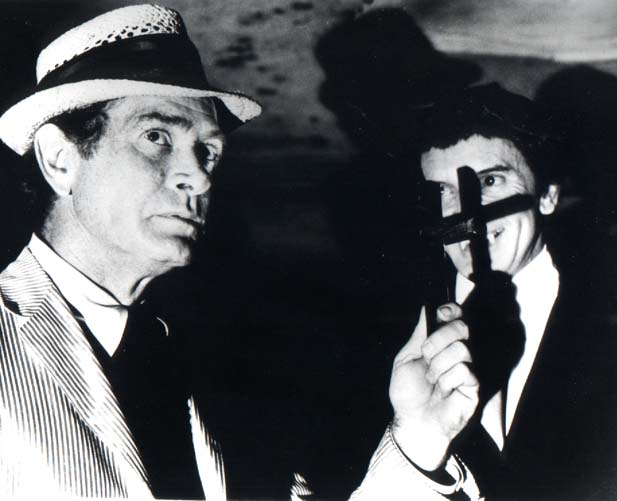
The year was 1985 and Los Angeles’ Night Stalker haunted our dreams and waking hours. Once the sun set, once the moon rose, my brother stood watch in our parents’ bedroom of our Pasadena home, holding the orange-tinted sheer curtains aside, looking for a very real serial killer. The thirteen killings of the hard-working suburbanites were bloody, brushed with satanic symbolism and sexual in nature, perfect to feed intense media speculation and public paranoia. Living mere miles from several of the murder sites (Eagle Rock, Glendale, Monterey Park, Whittier) my parents, siblings and I would sit around the dinner table, listening to the television news reports for the latest clue regarding the curious pattern of the Stalker.
There was the idea that the murders took place in homes near freeway exits, and then the killer might have focused on homes painted yellow. Our house was about a mile, maybe more, from the 210’s San Gabriel exit and was painted white with green shutters so we felt somewhat protected. But those suggestions were just that: suggestions. One never knew if a house was vulnerable. The crimes themselves varied. There were shootings, stabbings, and rapes. The victims were just as varied, the ages ranging from 84 to 8. As outsiders not exposed yet to FBI profiling and CSI methods of identification now popular, we couldn’t possibly know what was in the killer’s terrifying mind.
An early survivor of the Night Stalker saw enough to help create a crime artist’s rendering. We had a face to focus on, a devil’s face with the dark eyes, cut cheekbones, and black, longish hair. This man was easy to envision breaking into houses, cutting the owners up, leaving lipstick pentagrams on the walls. We saw him everywhere. In the supermarket, at the post office, in the car next to us. We knew this man.
The real break came towards the end of the Stalker’s run, from a series of victims who were able to provide a better physical description of the man and his orange Toyota, along with his license plate. The car was found abandoned. A fingerprint was gathered which lead to mug shots from previous crimes that would be publicized. Now we knew positively what the killer looked like.
So much so that when Richard Ramirez was on the move through an East Los Angeles neighborhood, he was spotted and physically attacked by a throng of anxious urbanites. The Spanish-speaking crew brought him down and brought him down hard. He was found cowering and beaten, the police having to protect him from a near-lynching. The next morning, the Los Angeles Times ran a photo of the scared Ramirez as he was put into the police unit. An aunt of mine said later, “You know, with guilt I say, he was kind of sexy.”
She wasn’t the only one to think so. In the years that followed, Ramirez developed a real following of women, receiving wedding proposals, money, countless offers of love. In 1998, he received the ultimate gift: the death penalty. Los Angeles could breathe again. We could sit now in peace until the next paranoia-inducing event, such as the air crash over Cerritos which set off a paranoia about mid-air collisions.
Today, I was reminded of those days when I read that Ramirez is seeking a new trial based on the lack of competence by his first lawyers. The timing of the article was rather…coincidental, being that today is the sixth day of the sixth month of the sixth year of the millennium, 6-6-6. The article claims the lawyers were too new to provide an adequate defense. One might think so considering Ramirez pretty much received the heaviest punishment with no mitigation. On the other hand, as his former lawyer, Arturo Hernandez, said in the article, “But we did it pro bono. Didn't get a penny. For free, I think we did a hell of a good job.” Well, I suppose one could argue that you get what you pay for.

In the meantime, while we wait for the results of the Ramirez effort, on this day, I’ll be sure to lock my windows and doors and keep an eye out for the ghosts in the shadows, for the devil walking my quiet suburban street.
Picture of Darren McGavin from: The Night Stalker
Picture of Richard Ramirez from: All Serial Killers
Monday, May 15, 2006
Mothers and Daughters

Insomnia grips me tonight, thoughts ranging from final exams to mothering to children to love to self-identity and self-awareness to body image to exercise to food to acid reflux to the hot night to perceptions to sleep to wakefulness. Six in the morning will come quick and still her voice bangs about in my head, her tears sticking to me like guilt.
“I was so hurt by how she spoke to me,” the sixty-five year-old mother said, dabbing the folded and refolded tissue to her reddened eyes, her long hair disappearing way beneath the edge of the table. “Why does she do that? We gave her everything and when I walked into the house, she didn’t hug me or come up to me like you did, wishing me a Happy Mother’s Day, she just stood there. Distant, cold, you know? What did I do wrong?”
“Maybe it’s fear. She lost her father and you’re all that’s left. She can’t take when you cry or are needy because that means you’ll die next. That means you’ll be leaving her, too.”
“You really think so?”
I have no idea, I thought.
“Yeah, sure,” I said.
What happens with mothers and daughters, what happens to tear apart their connection that so early on is so deep and fulfilling? I remember being unable to sit with my mother in her last days of coherence, unable to let her hang on to me to walk from room to room. I could barely look at her as she handed me her checkbook to write out bills, as she fumbled with the papers at the messy desk in the back room because she could not control her muscles very well. I was furious with her for being ill. I cringed when she touched me, physically recoiling from her increasing dependence. I stormed out of the house, ignoring her call to me. Days later she cried on the phone, trying to tell me she couldn’t see.
“What do you mean you can’t see?!”
“I can’t see, I can’t tell you what I need.”
“You can’t just look in the refrigerator and tell me whether there’s milk or not?! How can I help you if you can’t tell me what you need?!”
“No, mija, I can’t see! I can’t see!”
The conversation deteriorated from there, ending with her sobbing into the telephone and me hanging up the phone so I didn’t have to hear anymore. I hated her. I hated her illness because I didn’t believe it. I already lost my father and refused to accept that this was happening again.
Please, dear God, not again, not so soon.
In my mind, dying wasn’t happening. Dying wasn’t a possibility. She was immortal as always. She was making the whole thing up for attention, I told myself, and acted in response to that presumption. She was a liar.
Nothing makes up now for how I behaved. To this day, I still cringe, only not from her touch but from thinking of those months I cannot take back, thinking of what should have been. If it had been any other sort of disease…something I could see…
Why could I not wake up to her final illness? Yes, she burnt us out as her children on her many emotional disorders. Yes, yes, yes, there was reason for my tuning her out, for my shutting down and becoming a distant, cold daughter. Any therapist would rationalize and explain and urge me to forgive myself. A relative once said in an open moment, “Perhaps it was for the best. Who would have taken care of your mother? She only would have gotten worse emotionally. Sometimes I’m relieved to think of her being safe and sound in the cemetery.”
And yet…I want her.
“Have you tried talking to her, without accusation,” I asked, hesitating a bit because I was stepping into personal ground.
“She gets so angry, I can’t say anything.”
There are always reasons for daughters shutting down on their mothers. My aunts have a harder time accepting the various moods of my grandmother than me and my sister. They are often much less patient with her, visibly. I can listen to my grandmother go on and on about her aches and pains and yet I know my aunts have to cut the conversation short. I often hear their anxiousness.
They have their reasons.
Blog-touring shows me this breakdown over and over again. Books, I know, have been written about the strain. Competition, jealousy, a desire to toughen up the girls for the hard life that surely awaits them, self-absorption, illness, depression, insecurity, a myriad of reasons collapses the “sweetness.” Something goes terribly wrong somewhere down the road and I wonder about it now, tonight.
I think about the collapse when M cuddles up to me as I’m leaving to teach and says, “I want you!” When I prefer to disappear into the blackness that lurks always, I hear that cry and choose to step away from the isolation to embrace her and to be there for her. She demands in a way the boys don’t. She stomps her foot and screams, “I WANT YOU!”
“I love you,” she says when I show up.
What happens to shred that connection? What happens to deafen both mother and daughter to each other’s furious demand?
“Before her father got sick,” the mother recounted, “my daughter said in no uncertain terms, ‘I’m not going to take care of you when you get old.’ I told her we knew that, that we never expected it or asked her for it. But still it hurt what she said. We never understood it.”
Ancient hurt, I wanted to say. You must have hurt her first. You cannot be innocent in this problem. I shrug though, offering her only my empathy. I remembered a time when I bent to kiss my four year-old son and he bumped his head against mine, not wanting me to touch him. I cried all the way to my mother’s house, broken hearted at being rejected by my child. I know the hurt, on both sides, but I don’t know the pain of an adult child bumping heads, pushing away a kiss.
"I'm so sorry," I said.
“We gave her everything she ever wanted. I’ll never forget her telling me she couldn’t get me when I called her from the freeway after the car accident. She never called me back. I could have been killed and still she didn’t call me back. What did I do to her?”
“I don’t know – I wish I had an answer.”
There were hugs all around when it was time to leave, lies maybe. Hurt shoved down. The mother headed down the walk towards her car. I carried her things for her. She is alone now, widowed. The rejection intensifies the grief for her lost husband. We stood together under the branches of a large tree, the leaves shuddering in the summer night’s breeze. She spoke of a missing headstone and a memory of his fishing trips and the doors he never finished. We hugged and I said I loved her.
"You don't know how much that means to me," she sniffled. She got into the car at last and drove away, a crock pot half-full of uneaten baked beans in the trunk. Hours she'd spent making it and the daughter didn't keep the leftovers. She disappeared around the corner into the darkness.
M looked up at me as we walked to our car, her fingers in her mouth, her other hand grasping mine. The boys climbed into the truck and I shivered in an imagined chill, the Los Angeles sky devoid of stars.
“I love you, daughter,” I said.
M said nothing, curling up in her booster seat while I seatbelted her in.
Insomnia grips me tonight.
Friday, April 28, 2006
Pulling Teeth
I've been lazy about posting this week because we've been busy – sitting down and spitting out words has been as difficult as pulling teeth. Just didn’t want to do it. Had lots of papers to grade but didn’t feel like breaking out the pen and slashing away at the students’ work. Had a dentist appointment today but I didn’t want to go (hate, hate, hate the dentist!). It was a bad week for J in getting to school in the morning which made me dread waking up, too. There was a lot of homework for A which made me dread the kids coming home from school. M was great this week, though. She was a doll actually, which made me not want to ship her off to school.
The usual I suppose.
After the dentist appointment this morning, I had lunch with my grandmother and my sister. While eating, we got onto the subject of loose teeth. M has a couple of them and these teeth are really hanging on. We keep wiggling them but still they sit, rooted in.
Sister asked me, "Why don't you just pull them? Try with your fingers."
I shuddered, "I can't – can’t cause them any sort of pain that way. Can't pull teeth, can't clip fingernails, and I can't pluck eyebrows because I can't stand the sensation of plucking skin."
"I remember having a conversation about you with my friend – she and I are like monkeys, constantly grooming our children."
"But pulling teeth?"
"My kids pull their own teeth. You should see AH! Six years old and yanking the tooth out like a real Amazon woman.”
“Mine, too. The boys totally pulled their own teeth.”
“We really should use pliers,” Sister said. “Not even wait for the teeth to get loose.”
“Like Mommy did with us!”
We cackled, laughing a bit hysterically.
My grandmother chimed in, “Your mother did that because she inherited the ability to treat a human body without fear. My father used to remove bullets from the troops without blinking an eye.”
“But Mama Nana, we weren’t soldiers in the Mexican Revolution on the front line, we were her CHILDREN. She was…masochistic.”
“No, no,” I clarified, “She was a SADIST.”
“’Just hold on to the chair, mija!’” Sister mimicked herself as a child, holding the sides of the chair and screaming.
I laughed and shook my head, “What chair, she held me down in her arms and pulled those babies out with everything she had. I swear to GOD, my teeth weren’t loose.”
We laughed while my grandmother gnawed on a large roll. “I ruined my torta,” she said, her tone one of aggravation. “Shouldn’t have put it in the microwave. I could loose teeth on this.”
She didn’t want to hear us mocking our mother, shaking her head at us while we still chuckled and looked at each other in disbelief.
“But Mama Nana,” Sister said, “Our teeth weren’t loose.” She had such an expression of horror that I burst out laughing again, much to the chagrin of Mama Nana.
What can I say? It’s mostly true – the teeth she pulled those few times were somewhat loose. I have a particular memory of being in my mother’s arms on a chair in our old house on Holliston in Pasadena, tasting the metal of the pliers, and screaming like mad as she worked to get a tooth out. She pulled it out all right, smiling and waving the pliers about, “See? Not so bad, eh?”
The weird part is I cannot remember the pain. I know I felt it, why else would I be screaming? Granted, it could have been fear, the anticipation of pain that never came. Or the pain was so mild, I forgot about it. Or maybe it simply is a natural inability to recall physical pain. Have I written about this before? Sounds familiar. My mother used to say that women forget the pain of childbirth which is why they go on to have more children. If we could recreate in our head physical pain, the world would have fewer people.
Mama Nana finished her ruined torta, and we finished our remembrance of pulled teeth. I packed my bags and left to pick up A. After I shuttled A home, I turned back around and checked J out of school early in order to prevent him from slipping away after school under the guise of, “I forgot I was grounded.” I felt good about it…rather sneaky. I had warned him that if he was late again to school, he’d lose the computer and his friends for two days. I knew I surprised him and he even said, “Did you do this to stop me from going with my friends?”
“You bet your bippy, I did.”
“What’s a bippy?”
“I have no idea but you better not go looking for any.”
“I was kidding. I wasn’t going anywhere. I was just kidding.” He smiled hugely.
“Yeah, sure you were.” I smiled back at him and hugged him. “You little brat.”
You know, writing this wasn’t quite as bad as pulling teeth.
The usual I suppose.
After the dentist appointment this morning, I had lunch with my grandmother and my sister. While eating, we got onto the subject of loose teeth. M has a couple of them and these teeth are really hanging on. We keep wiggling them but still they sit, rooted in.
Sister asked me, "Why don't you just pull them? Try with your fingers."
I shuddered, "I can't – can’t cause them any sort of pain that way. Can't pull teeth, can't clip fingernails, and I can't pluck eyebrows because I can't stand the sensation of plucking skin."
"I remember having a conversation about you with my friend – she and I are like monkeys, constantly grooming our children."
"But pulling teeth?"
"My kids pull their own teeth. You should see AH! Six years old and yanking the tooth out like a real Amazon woman.”
“Mine, too. The boys totally pulled their own teeth.”
“We really should use pliers,” Sister said. “Not even wait for the teeth to get loose.”
“Like Mommy did with us!”
We cackled, laughing a bit hysterically.
My grandmother chimed in, “Your mother did that because she inherited the ability to treat a human body without fear. My father used to remove bullets from the troops without blinking an eye.”
“But Mama Nana, we weren’t soldiers in the Mexican Revolution on the front line, we were her CHILDREN. She was…masochistic.”
“No, no,” I clarified, “She was a SADIST.”
“’Just hold on to the chair, mija!’” Sister mimicked herself as a child, holding the sides of the chair and screaming.
I laughed and shook my head, “What chair, she held me down in her arms and pulled those babies out with everything she had. I swear to GOD, my teeth weren’t loose.”
We laughed while my grandmother gnawed on a large roll. “I ruined my torta,” she said, her tone one of aggravation. “Shouldn’t have put it in the microwave. I could loose teeth on this.”
She didn’t want to hear us mocking our mother, shaking her head at us while we still chuckled and looked at each other in disbelief.
“But Mama Nana,” Sister said, “Our teeth weren’t loose.” She had such an expression of horror that I burst out laughing again, much to the chagrin of Mama Nana.
What can I say? It’s mostly true – the teeth she pulled those few times were somewhat loose. I have a particular memory of being in my mother’s arms on a chair in our old house on Holliston in Pasadena, tasting the metal of the pliers, and screaming like mad as she worked to get a tooth out. She pulled it out all right, smiling and waving the pliers about, “See? Not so bad, eh?”
The weird part is I cannot remember the pain. I know I felt it, why else would I be screaming? Granted, it could have been fear, the anticipation of pain that never came. Or the pain was so mild, I forgot about it. Or maybe it simply is a natural inability to recall physical pain. Have I written about this before? Sounds familiar. My mother used to say that women forget the pain of childbirth which is why they go on to have more children. If we could recreate in our head physical pain, the world would have fewer people.
Mama Nana finished her ruined torta, and we finished our remembrance of pulled teeth. I packed my bags and left to pick up A. After I shuttled A home, I turned back around and checked J out of school early in order to prevent him from slipping away after school under the guise of, “I forgot I was grounded.” I felt good about it…rather sneaky. I had warned him that if he was late again to school, he’d lose the computer and his friends for two days. I knew I surprised him and he even said, “Did you do this to stop me from going with my friends?”
“You bet your bippy, I did.”
“What’s a bippy?”
“I have no idea but you better not go looking for any.”
“I was kidding. I wasn’t going anywhere. I was just kidding.” He smiled hugely.
“Yeah, sure you were.” I smiled back at him and hugged him. “You little brat.”
You know, writing this wasn’t quite as bad as pulling teeth.
Wednesday, March 22, 2006
Embracing Our Inner Lila
The medications are lined up on the window sill in our kitchen: anti-inflammatory pills for the bursitis in my shoulder, mood stabilizers, ADD medications and medication to reduce tics for the boys, antibiotics and Benedryl for the girl, three different blood pressure medications and Bayer for D, stomach and skin pills for the dog. That doesn’t include the stuff that lies all over the house: Aleve, Advil, Tylenol, Motrin, Children’s Tylenol and Children’s Motrin (chewable and liquid form), various cough syrups prescribed to me and the children over the past year, nighttime cold medicines, daytime cold medicines, children’s cold medicines (nighttime and daytime), a nose spray for D that doesn’t interfere with his prescribed medications, Prylosec, Pepcid, Mylanta, Tums, and the beloved bottle of leftover Vicodin that’s now down to the one pill. I’m saving that for a special night.
We are a medicated family – we believe in the power of modern medicine. Have an ache? Take a pill! Have a serious mental illness? Take a pill! Just enjoy the general idea of pill-popping? Take a pill!
We knew we had issues when M asked me in her little five-year-old voice, mispronouncing 'pills,' “Mama, when do I get to take the same pillows A and J take?”
“Oh honey, I’m sure when you hit third grade the bipolar will kick in and you’ll be just like everyone else in the house!”
“I can’t wait, Mama!”
“Me neither, honey!”
We grab hands and dance a jig, Sassy nipping at our ankles.
My mother was a medication fiend – for a while there she was a full-blown, live version of “Valley of the Dolls.” She had pills for everything, mostly imagined maladies. She went to several doctors, each of whom prescribed her a new medication or more medication for her latest problem. Big on the Valium. The worst experience (no, one of several drug-related incidents I recall) was when my sister and I found her laid out on her bed in just her underwear, relatively unconscious. She mumbled a few words, snored loudly, and had wet the bed. We called an ambulance. Lots of drama. My grandparents drove like mad folks to the emergency room. My father drove through horrible Los Angeles traffic from USC to Huntington Memorial. She was in a “coma.” The doctors…let me emphasize, the DOCTORS (twenty-thousand years of medical training under their belts) sat us down to inform us in the most solemn of tones that they did not know what was wrong with her, that they suspected a massive stroke.
My sister and broke out into muted laughter to the absolute horror of my grandparents (my father sort of tilted his head, nodded, in semi-agreement with us), “She hasn’t had a stroke…she’s overdosed on prescription pills and the finest tequila this side of the Rio Grande! What’s WRONG WITH YOU PEOPLE?!”
The doctors got very uncomfortable at that point and ordered a slew of toxicology tests. And of course we were correct in our medical diagnosis. She landed in a 72-hour psych-hold where she convinced the doctors her family poisoned her and they let her go. Oh no, no evidence of psychosis there! Poor thing – I’m sorry really that no doctor ever got past her beauty and seductive ways to properly diagnose her: bipolar disorder I, the heavy duty BPD, the one where a person can move from grandiosity and euphoria to suicidal ideation all within mere hours. At the time they called it, manic-depressive disorder.
Dearest mama.
Today, whenever any of the three of us get a little loopy on alcohol or whatever other substance might be lying around, or whenever we allow ourselves to sink into dramatic misery, we say we are embracing our “inner Lila.” Lila was our mother’s nickname. To embrace that part of us is to love her, is to appreciate the part of her we thought we hated.
What do they say about looking in a mirror?
On Monday, M came down with an ear infection, swimmer’s ear actually from playing mermaid one too many times in the bathtub. After the appointment (where A, M, and I played a great game of charades – another post for another time), prescription for ear medication in hand, I thought I should go ahead and fill the boys’ prescriptions too while I was at it. I picked up a couple of candy bars for my private stash in my room (where I keep other drugs: Girl Scout Cookies, real Bubble Gum, Reeses Peanut Butter Cups, a symbolic amount of pot). When the pharmacist rang up all the goodies, when he put in the amounts of the co-pays (we have the best insurance this side of … Pomona), he handed me a bill of $114.00.
“One hundred and WHAT?!” The DH screamed through the cell phone (a free call, mobile-to-mobile – thank you Verizon!).
“She has an ear infection, honey.”
“You know we already owe the psychiatrist $650.”
“He’s off the plan.”
“He needs to be OFF the plan.”
When I get home, the battle of the homework begins, A’s homework the biggest problem of all. M wants to play on the computer but J is playing the drums (practicing his latest in punk rock beats – the louder, the better!). She screams at the top of her lungs to shut up (and I mean, SCREAM). A lays down on the bench at the table, claiming to have sleeping sickness. The dog has gotten into the trash. The DH arrives shortly thereafter and launches into a rousing version of, “Why the hell didn’t anyone empty the dishwasher for the next load that’s stinking up the sink?!” It’s a familiar tune and I shrug…
“I don’t know, honey. Want a beer?”
“I don’t drink, you know that.”
“Yeah, well, I do.”
I cut up a lemon, stick a wedge into the Corona, and sprinkle salt on the bottle’s rim. I pop a Pepcid because the alcohol in conjunction with the stress of the afternoon will trigger acid reflux that I’ve had since I was a kid. I wonder if I have esophageal cancer. If I have it, I’m doomed.
D takes his dosage of blood pressure pills and flips through the mail, then heads off to do laundry.
The boys drink soda and eat some chips in front of the T.V., abandoning the homework.
M gathers her makeup and purses and hair decorations to play hair salon.
The dog runs out the back door and begins digging a hole to China.
I plop myself at the computer, sip my beer, and blog. Look at retreats.
We’re all medicated.
We are a medicated family – we believe in the power of modern medicine. Have an ache? Take a pill! Have a serious mental illness? Take a pill! Just enjoy the general idea of pill-popping? Take a pill!
We knew we had issues when M asked me in her little five-year-old voice, mispronouncing 'pills,' “Mama, when do I get to take the same pillows A and J take?”
“Oh honey, I’m sure when you hit third grade the bipolar will kick in and you’ll be just like everyone else in the house!”
“I can’t wait, Mama!”
“Me neither, honey!”
We grab hands and dance a jig, Sassy nipping at our ankles.
My mother was a medication fiend – for a while there she was a full-blown, live version of “Valley of the Dolls.” She had pills for everything, mostly imagined maladies. She went to several doctors, each of whom prescribed her a new medication or more medication for her latest problem. Big on the Valium. The worst experience (no, one of several drug-related incidents I recall) was when my sister and I found her laid out on her bed in just her underwear, relatively unconscious. She mumbled a few words, snored loudly, and had wet the bed. We called an ambulance. Lots of drama. My grandparents drove like mad folks to the emergency room. My father drove through horrible Los Angeles traffic from USC to Huntington Memorial. She was in a “coma.” The doctors…let me emphasize, the DOCTORS (twenty-thousand years of medical training under their belts) sat us down to inform us in the most solemn of tones that they did not know what was wrong with her, that they suspected a massive stroke.
My sister and broke out into muted laughter to the absolute horror of my grandparents (my father sort of tilted his head, nodded, in semi-agreement with us), “She hasn’t had a stroke…she’s overdosed on prescription pills and the finest tequila this side of the Rio Grande! What’s WRONG WITH YOU PEOPLE?!”
The doctors got very uncomfortable at that point and ordered a slew of toxicology tests. And of course we were correct in our medical diagnosis. She landed in a 72-hour psych-hold where she convinced the doctors her family poisoned her and they let her go. Oh no, no evidence of psychosis there! Poor thing – I’m sorry really that no doctor ever got past her beauty and seductive ways to properly diagnose her: bipolar disorder I, the heavy duty BPD, the one where a person can move from grandiosity and euphoria to suicidal ideation all within mere hours. At the time they called it, manic-depressive disorder.
Dearest mama.
Today, whenever any of the three of us get a little loopy on alcohol or whatever other substance might be lying around, or whenever we allow ourselves to sink into dramatic misery, we say we are embracing our “inner Lila.” Lila was our mother’s nickname. To embrace that part of us is to love her, is to appreciate the part of her we thought we hated.
What do they say about looking in a mirror?
On Monday, M came down with an ear infection, swimmer’s ear actually from playing mermaid one too many times in the bathtub. After the appointment (where A, M, and I played a great game of charades – another post for another time), prescription for ear medication in hand, I thought I should go ahead and fill the boys’ prescriptions too while I was at it. I picked up a couple of candy bars for my private stash in my room (where I keep other drugs: Girl Scout Cookies, real Bubble Gum, Reeses Peanut Butter Cups, a symbolic amount of pot). When the pharmacist rang up all the goodies, when he put in the amounts of the co-pays (we have the best insurance this side of … Pomona), he handed me a bill of $114.00.
“One hundred and WHAT?!” The DH screamed through the cell phone (a free call, mobile-to-mobile – thank you Verizon!).
“She has an ear infection, honey.”
“You know we already owe the psychiatrist $650.”
“He’s off the plan.”
“He needs to be OFF the plan.”
When I get home, the battle of the homework begins, A’s homework the biggest problem of all. M wants to play on the computer but J is playing the drums (practicing his latest in punk rock beats – the louder, the better!). She screams at the top of her lungs to shut up (and I mean, SCREAM). A lays down on the bench at the table, claiming to have sleeping sickness. The dog has gotten into the trash. The DH arrives shortly thereafter and launches into a rousing version of, “Why the hell didn’t anyone empty the dishwasher for the next load that’s stinking up the sink?!” It’s a familiar tune and I shrug…
“I don’t know, honey. Want a beer?”
“I don’t drink, you know that.”
“Yeah, well, I do.”
I cut up a lemon, stick a wedge into the Corona, and sprinkle salt on the bottle’s rim. I pop a Pepcid because the alcohol in conjunction with the stress of the afternoon will trigger acid reflux that I’ve had since I was a kid. I wonder if I have esophageal cancer. If I have it, I’m doomed.
D takes his dosage of blood pressure pills and flips through the mail, then heads off to do laundry.
The boys drink soda and eat some chips in front of the T.V., abandoning the homework.
M gathers her makeup and purses and hair decorations to play hair salon.
The dog runs out the back door and begins digging a hole to China.
I plop myself at the computer, sip my beer, and blog. Look at retreats.
We’re all medicated.
Tuesday, March 14, 2006
Johnny
Rachel lived near U.S.C. off of Western in a modest beige bungalow that hadn’t been painted since the Watts Riots. A mass of miniature palm trees, yucca trees, and camellia bushes packed the front yard. Getting to the front door was an act of ducking the green and whipping away the gnats. Tall stacks of newspapers crowded the porch and a skinny grey cat mewed at me from an old stand-alone swing.
The assignment was to talk to her for a short while, spend “quality time” with her. She was lonely – her husband had died years and years before and she had no children. The director of the Joint Educational Project told me she was nearing 88 and her health wasn’t good.
I knocked on the screen door, able to see inside the cluttered house. A billowing woman wearing a print housecoat shuffled from behind a wall-papered wall, coming to the door. She couldn’t have been more than five foot two, smiling, wearing bright-red lipstick. Her white hair was just as puffy as she was, brushed carefully into a quasi-bouffant, a pink-bow barrette to the side. Her eyes were moist and blue and she seemed so, so happy to have company.
She ushered me in and took my bag from me, laying it down next to an empty planter in the entranceway. She chattered, thinking I was from the synagogue she could no longer attend, but when I corrected her she remembered that she was approached by someone from the college.
“Oh yes,” she said, “such nice people.”
The kitchen was as ancient as her house – appliances, a table and chairs dating back to the fifties, green tiles, and plain cupboards painted yellow. She had a toaster covered by chicken-fabric. She stood at the counter on a small stool to bring down cookies. She arranged them on a plate and poured milk into two purple glasses that looked eerily similar to glasses my mother once got as a promotion from a gas station.
I asked her how long she lived in the house.
“Johnny and I bought this house in 1942. We thought it was the most beautiful house on the block. A real nice lawn in front. We loved to work in the garden. This is Johnny.”
With a serene smile on her face, she reached across the table and showed me a picture of a man in his 60’s maybe – white hair brushed to the side, wearing black-rimmed glasses. The color picture had faded as if she kept the framed shot in the sun. I took the picture into my hands and nodded appreciatively.
“He looks like a very nice person.”
“He was so smart – he was an engineer. Worked for the city. He used to take me to all the buildings he worked at. He died of pneumonia.” Her face changed a little, but then she resumed the smile again. She ate a cookie, taking small bites at a time. I ate, too, drinking some milk to wash down the basic chocolate chip.
We talked some more and then she wanted to share something with me. She shuffled away and for the first time I noticed her slippers, pink and fluffy. When she returned, she had a cassette in her hand. She sat down at her seat and put the tape into a black tape recorder. She pressed the play button, her face serious, anticipating what she’d hear.
A man’s voice crackled out of the recorder – he was singing something I didn’t recognize. Sounded like a folk song. Rachel lit up, looking at me.
“Doesn’t he have a beautiful voice?”
“Yes, he does,” I said.
The song ended and he laughed, making a comment about the machine. “Rachel what do I push? My Rachel, you can do these things better than me.”
“Oh Johnny!”
She laughed along with herself on the tape. “Johnny always made me laugh.”
“You’re my life, honey. Come and sing with me. I’m not the only one who’s going to be a fool on this machine.”
“You couldn’t be a fool, Johnny.”
“I love you, honey.”
“I love you, too.”
The two laughed together on the tape and then Rachel shut the recorder off, smiling at me. “This is the only thing I have left of my Johnny. I listen to him every day, whenever I feel like I miss him.”
She pressed a red-painted fingernail on the machine. We listened to Johnny talking about work and about his parents. How they lived in New York City in the Bronx and had died in the fifties. The tape showed a sliver of a tender and lasting relationship between two people alone in this life – she still hadn’t let go of him. I couldn’t blame her. I took a furtive glance at the living room seeing a house full of collections. Old radios lined shelves, curio cabinets overflowed with porcelain trinkets, and throw rugs draped the furniture and floors.
We talked about Rachel’s schedule which wasn’t much. Get up in the morning, shower, dress for the day. Make breakfast for herself. Clean the house a little. Not so much anymore. Not with her arthritis and heart problems. Lunch. Listen to Johnny. A girl from the synagogue brought groceries twice a week. I’m lonely, she said. I miss conversation, she said.
I checked my watch and smoothed my skirt and blouse, smiling at Rachel, telling her in turn about my schedule. I said I know love, but not like yours.
“Nobody’s like Johnny.”
“No,” I agreed, taking her hand in mine.
I glanced up at the clock on her wall, a plain one with black hands and red second hand, and the hour told me it was time to go. Our time was up. She walked me to the door and I shook her hand. I’d be back next week. This was lovely, I told her.
“Thank you,” I said, “For telling me about Johnny.”
“I miss him so much.”
“Who wouldn’t?”
She smiled and I stepped out the door into the wild brush along the walkway, hearing the door slam gently against the frame. I turned and waved and she waved back, her form shadowed behind the screen.
We met only a few times more, each time, Johnny’s crooning accompanying our conversation. The last time I saw her was a rare rainy day in Los Angeles, water pouring onto her porch due to clogged drain pipes, the cat nowhere to be seen. Rachel was in tears when she opened the door for me. Someone had broken into her house when she was at a doctor’s appointment and had taken her tape recorder with the tape still inside.
There was nothing I could do or say to console her. I held her hand as she cried and cried. She’d lost Johnny.
My assignment had ended. The next person I was given was a brisk ninety-five year old woman who used the students from U.S.C. to shuttle her around like a taxi service – against the rules due to liability issues. The director warned me not to let her suck me into her schedule. I got sucked in, taking her to a doctor or two, to the store once or twice. The next job, the last one before I abandoned the idea of being a social worker, had been to volunteer at St. John of God’s convalescent hospital on West Adams Boulevard with Alzheimer patients who often had forgotten love, along with everything else that mattered in a daily life. I pushed the patients around in their wheel chairs in the garden or fed them their lunches.
I thought for a long while after that perhaps forgetting was better than remembering.
The assignment was to talk to her for a short while, spend “quality time” with her. She was lonely – her husband had died years and years before and she had no children. The director of the Joint Educational Project told me she was nearing 88 and her health wasn’t good.
I knocked on the screen door, able to see inside the cluttered house. A billowing woman wearing a print housecoat shuffled from behind a wall-papered wall, coming to the door. She couldn’t have been more than five foot two, smiling, wearing bright-red lipstick. Her white hair was just as puffy as she was, brushed carefully into a quasi-bouffant, a pink-bow barrette to the side. Her eyes were moist and blue and she seemed so, so happy to have company.
She ushered me in and took my bag from me, laying it down next to an empty planter in the entranceway. She chattered, thinking I was from the synagogue she could no longer attend, but when I corrected her she remembered that she was approached by someone from the college.
“Oh yes,” she said, “such nice people.”
The kitchen was as ancient as her house – appliances, a table and chairs dating back to the fifties, green tiles, and plain cupboards painted yellow. She had a toaster covered by chicken-fabric. She stood at the counter on a small stool to bring down cookies. She arranged them on a plate and poured milk into two purple glasses that looked eerily similar to glasses my mother once got as a promotion from a gas station.
I asked her how long she lived in the house.
“Johnny and I bought this house in 1942. We thought it was the most beautiful house on the block. A real nice lawn in front. We loved to work in the garden. This is Johnny.”
With a serene smile on her face, she reached across the table and showed me a picture of a man in his 60’s maybe – white hair brushed to the side, wearing black-rimmed glasses. The color picture had faded as if she kept the framed shot in the sun. I took the picture into my hands and nodded appreciatively.
“He looks like a very nice person.”
“He was so smart – he was an engineer. Worked for the city. He used to take me to all the buildings he worked at. He died of pneumonia.” Her face changed a little, but then she resumed the smile again. She ate a cookie, taking small bites at a time. I ate, too, drinking some milk to wash down the basic chocolate chip.
We talked some more and then she wanted to share something with me. She shuffled away and for the first time I noticed her slippers, pink and fluffy. When she returned, she had a cassette in her hand. She sat down at her seat and put the tape into a black tape recorder. She pressed the play button, her face serious, anticipating what she’d hear.
A man’s voice crackled out of the recorder – he was singing something I didn’t recognize. Sounded like a folk song. Rachel lit up, looking at me.
“Doesn’t he have a beautiful voice?”
“Yes, he does,” I said.
The song ended and he laughed, making a comment about the machine. “Rachel what do I push? My Rachel, you can do these things better than me.”
“Oh Johnny!”
She laughed along with herself on the tape. “Johnny always made me laugh.”
“You’re my life, honey. Come and sing with me. I’m not the only one who’s going to be a fool on this machine.”
“You couldn’t be a fool, Johnny.”
“I love you, honey.”
“I love you, too.”
The two laughed together on the tape and then Rachel shut the recorder off, smiling at me. “This is the only thing I have left of my Johnny. I listen to him every day, whenever I feel like I miss him.”
She pressed a red-painted fingernail on the machine. We listened to Johnny talking about work and about his parents. How they lived in New York City in the Bronx and had died in the fifties. The tape showed a sliver of a tender and lasting relationship between two people alone in this life – she still hadn’t let go of him. I couldn’t blame her. I took a furtive glance at the living room seeing a house full of collections. Old radios lined shelves, curio cabinets overflowed with porcelain trinkets, and throw rugs draped the furniture and floors.
We talked about Rachel’s schedule which wasn’t much. Get up in the morning, shower, dress for the day. Make breakfast for herself. Clean the house a little. Not so much anymore. Not with her arthritis and heart problems. Lunch. Listen to Johnny. A girl from the synagogue brought groceries twice a week. I’m lonely, she said. I miss conversation, she said.
I checked my watch and smoothed my skirt and blouse, smiling at Rachel, telling her in turn about my schedule. I said I know love, but not like yours.
“Nobody’s like Johnny.”
“No,” I agreed, taking her hand in mine.
I glanced up at the clock on her wall, a plain one with black hands and red second hand, and the hour told me it was time to go. Our time was up. She walked me to the door and I shook her hand. I’d be back next week. This was lovely, I told her.
“Thank you,” I said, “For telling me about Johnny.”
“I miss him so much.”
“Who wouldn’t?”
She smiled and I stepped out the door into the wild brush along the walkway, hearing the door slam gently against the frame. I turned and waved and she waved back, her form shadowed behind the screen.
We met only a few times more, each time, Johnny’s crooning accompanying our conversation. The last time I saw her was a rare rainy day in Los Angeles, water pouring onto her porch due to clogged drain pipes, the cat nowhere to be seen. Rachel was in tears when she opened the door for me. Someone had broken into her house when she was at a doctor’s appointment and had taken her tape recorder with the tape still inside.
There was nothing I could do or say to console her. I held her hand as she cried and cried. She’d lost Johnny.
My assignment had ended. The next person I was given was a brisk ninety-five year old woman who used the students from U.S.C. to shuttle her around like a taxi service – against the rules due to liability issues. The director warned me not to let her suck me into her schedule. I got sucked in, taking her to a doctor or two, to the store once or twice. The next job, the last one before I abandoned the idea of being a social worker, had been to volunteer at St. John of God’s convalescent hospital on West Adams Boulevard with Alzheimer patients who often had forgotten love, along with everything else that mattered in a daily life. I pushed the patients around in their wheel chairs in the garden or fed them their lunches.
I thought for a long while after that perhaps forgetting was better than remembering.
Sunday, February 12, 2006
We Three...
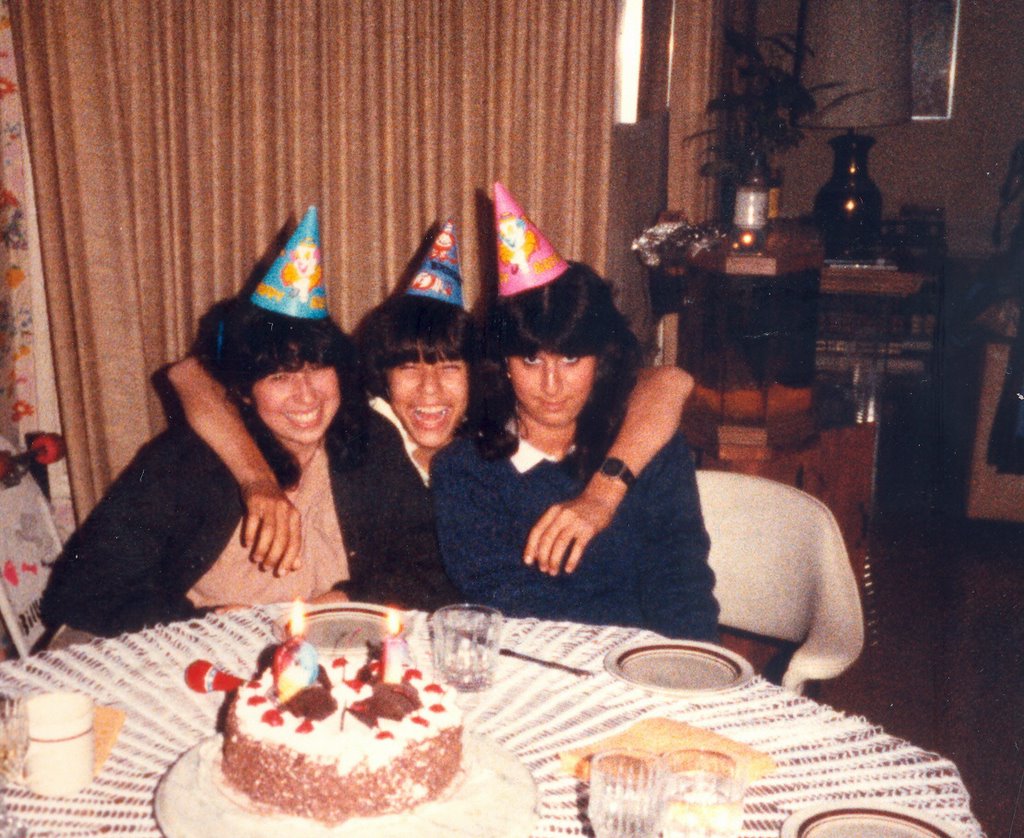
Spent Saturday night at the Twin Palms in Pasadena for T's birthday – D and I spent an entire evening with just the "grown-ups”: my brother B and his wife T, my sister A and her husband DH. The six of us. We ate well, we drank cocktails, and danced to disco music like we were all just dating, like we were free of everything that binds. We laughed and made fun of others...throwing stones as if we didn’t live in glass houses...but in the end what made us laugh the most were our own reflections.
I am always amazed at the closeness of my siblings and I - how it is that today we are best friends - that given the choice of going out with friends or each other, we will choose each other. We simply have too much fun. The inside jokes are ancient, the experiences we've shared are unique, our faults are totally understood. Our connection is rooted in difficulty, in survival, despite vastly different viewpoints of the same childhood environment.
B is infinitely harder in judgment on my father than on my mother. My sister and I are harder on my mother. He was the one who fought them the most – my sister and I were much more compliant, much more accepting of our circumstances, trying the mend the problems, trying to live as best we could within the chaotic confines of the Pasadena house.
One of the byproducts of the “difficult childhood” was that our struggles were unacknowledged. From the outside, being the children of glamorous parents, we couldn’t possibly have any complaints. Cousins and friends saw us as privileged and lucky, oh-so-lucky to have the favorites as our parents. How fun to live with the hosts of the party! How fun to have parents who’d travel and go to Disneyland at the drop of a hat or drive up the coast on a moment’s notice and stay in fancy hotels! How fun! How amazing to live in the old house with the huge pine tree behind that red brick wall…a house big enough to have a gate at the end of the driveway. How fun to zip around in sports cars on your dad’s lap! Nobody does those things!
How could such a life be bad?
We became isolated…nobody understood what we saw, day to day. We were forgotten when our parents could no longer hold it together – my mother being hospitalized – my mother disappearing one summer into the depths of Mexico – my father living away from the house. They occupied the spotlight in their downslide just the way they did when they were on top of their game.
Nobody understood the pain of living in that house.
For a while, we three traveled on slightly different roads. B was busy growing into adulthood, getting his college degree, while I was already there, lawyer-ing, getting married, having my first baby. My sister A was right behind me, working the corporate world, getting married. My parents were divorced, my father dying. When his death happened, the three of us had huddled together in handling the difficult process of telling my mother about his death and honoring my father’s wish that she not be at the funeral. My father had remarried. He’d alienated his own family. The politics of his funeral were…horrible. I remember my brother calling my mother – he’d taken on the chore of telling her not to come. Took the brunt of her anger. I think it was the first time I saw B as an adult.
Years later, B was divorced, I had my third child, and my sister had two. My mother died. All the work we’d done to repair hurt feelings since my father’s death seemed a grateful close call. We had no idea she’d leave us so soon. The three of us were left with the job of closing up her life – we three took on different tasks. I handled the probate, B handled the cleaning of her house, and my sister worked on getting the house sold.
This adult-orphan-hood has been yet another challenge from our parents…another reason for the three of us to be isolated from the extended family. Nobody knew our childhood for its reality, now few know our adulthood. We are the only ones of our generation in our family who lost both parents…making us once again, as always, different. We three…
B got married to T in Maui, Hawaii – we really love her. She fit in perfectly with our already-tight crew, not an easy hurdle. We three are now all matched, making for an even set of six.
Maui for the wedding was an amazing trip – the lot of us traveling so far together and staying in this beautiful villa together for a week. While I have many wonderful memories of the week, one in particular remains the definition of the relationship we share.
We had booked a popular boat trip for all of us to go snorkeling in Molokini, a lovely bay filled with brilliant coral and fish, the sort of place snorkeling was created for. The boat was great, the view lovely, and the weather perfect. When we arrived at Molokini, we got our snorkeling gear on…the three of us…with the spouses and kids. We’d never done it before so figuring out the proper fitting of the equipment took some effort. Well, we jumped in the water and all of us learned to do some basic snorkeling. Everyone was having a wonderful time…
Towards the end of the designated snorkeling time, my brother, my sister, and I, found ourselves alone away from the rest of the crowd. We had those face masks on, the breathing tubes pointing up to the blue sky…we were kicking in the water with our fins, swimming and admiring the view. All at once, we realized how silly we looked. We began making faces underwater, making those signals that scuba divers do, purposely slowing movements in the water, putting our thumbs up, putting them down…we were in stitches, sucking in water, laughing, drowning…just the three of us…kids again…on a fantastic trip, on one to be envied…a prince…princesses…we were ridiculous and carefree. I don’t know when I’ve laughed so hard in my life as that morning in the cool ocean, with just the three of us. Laughing at our own reflections.
Our roads have finally come together – we are all raising families, we are all working to make ends meet. We three have built a tight defense against the outside world – we’ve never connected more. So…dancing to disco, feeling the light effects of Lemon Drops and love, life is good. We’re not alone at all…we’re in the middle of a crowd.
Sunday, January 22, 2006
Windy Nights
The wind is blowing frightfully hard here in the Los Angeles suburbs, pressing against the windows, reminding me of how terrifying this same kind of wind used to be when I lived in Pasadena with my parents. The wind was so strong once that it literally blew down a massive pine tree in our front yard, blew it down so all 90 feet of it crashed in between our house and the one next door.
We had been watching that tree in our darkened kitchen for all the electricity had gone out. My father stood at the sliding glass door with my younger brother next to him. We were talking about what would happen if that tree fell, that beautiful, pine-needle-sprinkling tree that certainly saw the development of our neighborhood back in the late 1800's. I was 18 years old and you'd think my constitution would have been stronger, way past the time when I was afraid of the dark or the boogie man. I was sitting at the kitchen table when all of a sudden my father yelled out that the tree was falling, get out! Time seemed to have stopped for me and I heard the tree literally being yanked out of the ground and crashing downwards. I had stood and turned to get out only I tripped on the chair and crashed, too, right down on the floor, imagining the house was coming down around me. My father pulled me by the arm, dragging me away from the kitchen, until I could get up and run with him outside.
I stood outside, the wind whipping around me and the tree...the tree down on the ground, huge and helpless, branches punched through the neighbors' roof, conveniently though lying right in between our two houses. Safely fallen. Miraculously fallen.
For many nights after, for years after, whenever wind blew hard against the windows, I would be overcome with an overwhelming sense of insecurity. Never before had there been a more perfect metaphor come to life for what I felt about living in the Pasadena house what with my parents' constant dramas.
When I married and moved, only when my father was near death did the wind scare me again. The fear faded only to be reinvigorated with my mother's passing. The fear receded once more. Until tonight. I'm in my office preparing for tomorrow's lecture and I'm scared of the wind as it presses the glass windows, as it makes the vent in the garage whirl wildly.
I don't wonder why I'm feeling this way, however. Last week we learned why J's behavior has so intensified, why for the past couple of months he's been making horrific choices when given options - such as choosing to shoplift a trinkette in a store when visiting the mall with a church group - such as choosing to disappear in the neighborhood with friends when making a trip from right next door back home - such as choosing to self-destruct with regard to his grades, dropping from the cursed D's to F's, even in the face of losing that which he loves most in this world, his drumset. I took him finally to be evaluated and the doctor said he's presenting classic symptoms of bipolar disorder, just like his brother, just like my mother.
For months now, J has become the primary focus of the family - becoming a mini-tornado in our home, causing disruption wherever he is, from the moment he wakes up until the moment he goes down at night, always later than we want, always in defiance.
He's made me extremely insecure.
So the wind is blowing, I'm scared and I'm grasping once again to those little things in life to make me...happy. Moments of simplicity, or peacefulness, or joy.
Sitting in my grandmother's kitchen, eating chilaquiles and drinking instant coffee, while the sun pours in from the window right onto the table, warming the both of us, warming us as we talk about the family.
Driving in the car, coming home from dinner and a visit to the car dealership, D and I talk about how good it is that we found a new car for a price that won't kill our budget, that it's all going to work out just fine. We are practically giddy.
Picking up A from school and watching him lip synch Johnny Cash's "Ring of Fire". He knows all the words and it is so funny to "see" such a deep voice singing about passionate love coming from such an angelic, smiling, still-a-baby face. We both laugh and laugh all the way home while Sassy sticks her head outside the open window, lapping at the breeze.
Walking around Barnes & Noble, deciding I'm going to spend $40 on books I'll never finish. I'm joyous.
Talking about movies and television with my friend, happy...happy. Isn't Keifer a beauty? Isn't it great the Shield is back on and smokin'? Doesn't every reality show suck, suck, suck? Yes! Wasn't King Kong great and how in love am I with Juaquin Phoenix? I'm relieved for the simplicity of it all.
Thinking about writing a post on Ray's Market, the treasure trove down the road. How it looks through my children's eyes, how it will look in their eyes when they look back on it as adults. How wonderful!
The wind is pounding our trees, the windows really take it well. I'm certain no trees will fall this night.
We had been watching that tree in our darkened kitchen for all the electricity had gone out. My father stood at the sliding glass door with my younger brother next to him. We were talking about what would happen if that tree fell, that beautiful, pine-needle-sprinkling tree that certainly saw the development of our neighborhood back in the late 1800's. I was 18 years old and you'd think my constitution would have been stronger, way past the time when I was afraid of the dark or the boogie man. I was sitting at the kitchen table when all of a sudden my father yelled out that the tree was falling, get out! Time seemed to have stopped for me and I heard the tree literally being yanked out of the ground and crashing downwards. I had stood and turned to get out only I tripped on the chair and crashed, too, right down on the floor, imagining the house was coming down around me. My father pulled me by the arm, dragging me away from the kitchen, until I could get up and run with him outside.
I stood outside, the wind whipping around me and the tree...the tree down on the ground, huge and helpless, branches punched through the neighbors' roof, conveniently though lying right in between our two houses. Safely fallen. Miraculously fallen.
For many nights after, for years after, whenever wind blew hard against the windows, I would be overcome with an overwhelming sense of insecurity. Never before had there been a more perfect metaphor come to life for what I felt about living in the Pasadena house what with my parents' constant dramas.
When I married and moved, only when my father was near death did the wind scare me again. The fear faded only to be reinvigorated with my mother's passing. The fear receded once more. Until tonight. I'm in my office preparing for tomorrow's lecture and I'm scared of the wind as it presses the glass windows, as it makes the vent in the garage whirl wildly.
I don't wonder why I'm feeling this way, however. Last week we learned why J's behavior has so intensified, why for the past couple of months he's been making horrific choices when given options - such as choosing to shoplift a trinkette in a store when visiting the mall with a church group - such as choosing to disappear in the neighborhood with friends when making a trip from right next door back home - such as choosing to self-destruct with regard to his grades, dropping from the cursed D's to F's, even in the face of losing that which he loves most in this world, his drumset. I took him finally to be evaluated and the doctor said he's presenting classic symptoms of bipolar disorder, just like his brother, just like my mother.
For months now, J has become the primary focus of the family - becoming a mini-tornado in our home, causing disruption wherever he is, from the moment he wakes up until the moment he goes down at night, always later than we want, always in defiance.
He's made me extremely insecure.
So the wind is blowing, I'm scared and I'm grasping once again to those little things in life to make me...happy. Moments of simplicity, or peacefulness, or joy.
Sitting in my grandmother's kitchen, eating chilaquiles and drinking instant coffee, while the sun pours in from the window right onto the table, warming the both of us, warming us as we talk about the family.
Driving in the car, coming home from dinner and a visit to the car dealership, D and I talk about how good it is that we found a new car for a price that won't kill our budget, that it's all going to work out just fine. We are practically giddy.
Picking up A from school and watching him lip synch Johnny Cash's "Ring of Fire". He knows all the words and it is so funny to "see" such a deep voice singing about passionate love coming from such an angelic, smiling, still-a-baby face. We both laugh and laugh all the way home while Sassy sticks her head outside the open window, lapping at the breeze.
Walking around Barnes & Noble, deciding I'm going to spend $40 on books I'll never finish. I'm joyous.
Talking about movies and television with my friend, happy...happy. Isn't Keifer a beauty? Isn't it great the Shield is back on and smokin'? Doesn't every reality show suck, suck, suck? Yes! Wasn't King Kong great and how in love am I with Juaquin Phoenix? I'm relieved for the simplicity of it all.
Thinking about writing a post on Ray's Market, the treasure trove down the road. How it looks through my children's eyes, how it will look in their eyes when they look back on it as adults. How wonderful!
The wind is pounding our trees, the windows really take it well. I'm certain no trees will fall this night.
Friday, December 02, 2005
Slides on a White Sheet
Saw a great movie this evening - "Walk the Line" - really good, I was moved by the love, the journey, the pursuit of an artistic dream, the wish for safe simplicity.
Where have I been this week?
Thanksgiving was relaxed - two dinners on two days - sisters-in-law each doing the turkey, letting me do fun stuff like deadly-sugared yams and alcohol-drenched stuffing. Oh and the pumpkin pie from Marie Callendar's with luscious whipped cream. On Saturday, the day of the second dinner, my brother dragged out old slides, from when we were children, and we watched our own young faces in photos taken by my father...watched my parents' 30-something faces flash by, clicking by with no music, without the benefit of a sexy computer program to entertain us by crumpling pictures or pixelizing them as the show moved from slide to slide.
My dad loved photography and he took wonderful pictures that absolutely captured the era, their beauty, our sweetness. How well those pictures covered up the pain, the drama of their real lives, of what came later when their marriage finally blew up, emotional shrapnel whipping through all of us. B, my brother, and A, we all laughed and approved and mocked and sighed as we sat in the darkened living room, watching the shots against a wrinkled white sheet hanging along a set of drapes. The light of the projector and the sounds of the slides dropping into the lit pocket of the machine drifted throughout the room, like something ethereal, like the memories of the pictures themselves.
I left the dinner missing my father above all - missing his humor, missing the mystery of him. Among the pictures were images of a friend of theirs, JB. I recall him vividly. He lived next door to us - I remember him one time vigorously brushing his teeth, in his bathroom in his small cottage, five-year-old me watching him and asking him questions. I remember him riding a bike. He had reddish, curly hair, he spoke Spanish, and he was kind to us. I believe he loved my mother. I believe she was not averse to him either. But I don't really know the details...I wonder if it's true. What else did he see in my mother, other than the obvious? What did he think of my father? What does he remember...tell me anything, everything.
I searched for him on the internet, a quirk I have in that I know his real name. I'm tempted to write him, to ask him, "Do you remember us, do you remember them then?" I did locate him, where he works now (a professor of course at a technical university). I almost felt as if I was looking for my father...as if I'd actually found him. I was reminded of a fantasy that haunted me for the longest time after his death - the one where he never died, but had simply left, run away to start a new life. Time and time again I'd "see" him passing me by on the road in his favorite sports car, I'd swear he'd be at street corners or in the mall. I remember a time staring at the hands of a client because the hands looked so much like my father's I could barely hear the needs of the client. A trust, I think, a trust for the client and his wife. Look how he puts his hands together, look how he plays with the watch band...the hair on his arms...the cuffs folded over...
I was in a weird place on Sunday - not depressed, not sad, not peaceful, no, I was filled with a kind of anxiety that had no outlet. Something simmered within, making me impatient.
I know I'll never contact that man because to do so might destroy the fantasy that Papa is working, working well and successfully, accomplishing his dreams.
But I have to ask - why do I continue to grieve these parents of mine? Why do they lurk constantly in everything I do...I don't know.
*******
Wednesday afternoon, A lost his temper, ending up in a bit of a breakdown at the prospect of homework. Took him an entire hour to gain some self-control and calmness and once he did, it was as if nothing had happened. Earlier, his teacher just shook her head at my query as to how he was doing, "It's so hard to get him to write anything or do any math."
"Can you e-mail me...I feel like you're not keeping in good contact--"
"We have a parent-teacher conference, next week."
"Oh right...okay, we'll talk then."
Useless, helpless me.
That same afternoon, M clung to me when I tried to leave for class near six. J fussed and argued against our efforts to get him to study for a quiz. By the time I arrived at school, I felt drained, empty of anything to offer my students. Listlessly after an uninspired, thankfully-short lecture, I handed out an in-class assignment and walked the room, helping where I could. The students raised their hands for help and I went to them, answering their questions, correcting their work to better prepare them for next week's final exam. One woman called me over and kept writing as she asked me a question. An older student of Hispanic descent, she wore largish, stylish frames, and with soft hands, wrote in a halting and unsure style(how familiar those hands looked to me!). Then I noticed the skin beneath her eyes was moist, as if her eyes had watered with the hard work. I realized quickly, no, she's crying.
I put my hand on her shoulder and leaned down a tad so I could better see her face. The tears began to really flow then.
"Oh dear," I said, "You're really having a hard time, aren't you? Oh no..." I sat down immediately and went over each question with her. I'd wanted to go home but there was no way - we stayed later, late, after everyone left, and another student and I looked at a take-home assignment with her, going over everything, assuring her that she was on the right track. I helped where I could...told her she just needed more experience and that she'd get it in time.
"I can't seem to get past this point..." And the tears bubbled over once more. I felt so sorry for her - I knew that hurt - that feeling that everyone else seems to "get it". Useless, helpless me. For some reason...she reminded me of my mother. Only a few times did my mother's real-life tears move me...and this lady's tears...well, they moved me.
Back to the parents again.
The tearful student left near 10:15 p.m., still sniffling as she headed down the walkway to her car. The assisting student then asked to perform a poem for her speech class, "A power poem for a woman who works, who loves, who lives," in practice. I smiled and listened and offered praise for her hard work, for a very challenging project.
Home at 10:50 p.m. The house is quiet. The rooms are darkened with sleep. Sassy is wagging her tail at me, having met me at the door.
Sometimes, I find myself disappearing into my parent's old drama and I'm small and helpless again, waiting for them to remember me.
*******
When I was a child, my world revolved around the drama of my parents. As an adult, my world revolves around the drama of my children. All of them seem louder than me, more demanding than me. I'm sandwiched between layers of seeming, suffocating chaos. How strange that is.
*******
Christmas is coming and D put lights up on the house. We'll have a Christmas tree, we'll spend a little more money, money we don't have. Sometimes D infuriates me - little things, annoying things. I hate that we're so disparate in our artistic likes - in turn, he doesn't read what I write, other than the occasional once-over and his response is always lukewarm.
But I didn't marry him for our artistic "symbiosis." I married him because together we'd create a home with a proverbial picket fence, a colorful Christmas tree in the window, and a dog barking in the backyard. I married him because together we'd not be dramatic. And so it is relievingly mundane that in the evening we sit, legs and feet intertwined on the couch, watching a television show, or lie in bed, reading our books, or sit in a booth in a suburban restaurant, eating a steak and veggies dinner and talking about our children...how funny they are, how smart they are, how aggravating they are...did you see M with her hair in a bow and those mismatched clothes?! How much is the bill? Is this a POS...no let's use the credit card...I want dessert though. Let's be adventurous and order a Tiramisu! USC is playing UCLA this weekend...we going to Auntie's? Is that the bill? How much is it?
How funny it is we created drama out of our desperate need for simplicity, a generation beneath us.
Where have I been this week?
Thanksgiving was relaxed - two dinners on two days - sisters-in-law each doing the turkey, letting me do fun stuff like deadly-sugared yams and alcohol-drenched stuffing. Oh and the pumpkin pie from Marie Callendar's with luscious whipped cream. On Saturday, the day of the second dinner, my brother dragged out old slides, from when we were children, and we watched our own young faces in photos taken by my father...watched my parents' 30-something faces flash by, clicking by with no music, without the benefit of a sexy computer program to entertain us by crumpling pictures or pixelizing them as the show moved from slide to slide.
My dad loved photography and he took wonderful pictures that absolutely captured the era, their beauty, our sweetness. How well those pictures covered up the pain, the drama of their real lives, of what came later when their marriage finally blew up, emotional shrapnel whipping through all of us. B, my brother, and A, we all laughed and approved and mocked and sighed as we sat in the darkened living room, watching the shots against a wrinkled white sheet hanging along a set of drapes. The light of the projector and the sounds of the slides dropping into the lit pocket of the machine drifted throughout the room, like something ethereal, like the memories of the pictures themselves.
I left the dinner missing my father above all - missing his humor, missing the mystery of him. Among the pictures were images of a friend of theirs, JB. I recall him vividly. He lived next door to us - I remember him one time vigorously brushing his teeth, in his bathroom in his small cottage, five-year-old me watching him and asking him questions. I remember him riding a bike. He had reddish, curly hair, he spoke Spanish, and he was kind to us. I believe he loved my mother. I believe she was not averse to him either. But I don't really know the details...I wonder if it's true. What else did he see in my mother, other than the obvious? What did he think of my father? What does he remember...tell me anything, everything.
I searched for him on the internet, a quirk I have in that I know his real name. I'm tempted to write him, to ask him, "Do you remember us, do you remember them then?" I did locate him, where he works now (a professor of course at a technical university). I almost felt as if I was looking for my father...as if I'd actually found him. I was reminded of a fantasy that haunted me for the longest time after his death - the one where he never died, but had simply left, run away to start a new life. Time and time again I'd "see" him passing me by on the road in his favorite sports car, I'd swear he'd be at street corners or in the mall. I remember a time staring at the hands of a client because the hands looked so much like my father's I could barely hear the needs of the client. A trust, I think, a trust for the client and his wife. Look how he puts his hands together, look how he plays with the watch band...the hair on his arms...the cuffs folded over...
I was in a weird place on Sunday - not depressed, not sad, not peaceful, no, I was filled with a kind of anxiety that had no outlet. Something simmered within, making me impatient.
I know I'll never contact that man because to do so might destroy the fantasy that Papa is working, working well and successfully, accomplishing his dreams.
But I have to ask - why do I continue to grieve these parents of mine? Why do they lurk constantly in everything I do...I don't know.
*******
Wednesday afternoon, A lost his temper, ending up in a bit of a breakdown at the prospect of homework. Took him an entire hour to gain some self-control and calmness and once he did, it was as if nothing had happened. Earlier, his teacher just shook her head at my query as to how he was doing, "It's so hard to get him to write anything or do any math."
"Can you e-mail me...I feel like you're not keeping in good contact--"
"We have a parent-teacher conference, next week."
"Oh right...okay, we'll talk then."
Useless, helpless me.
That same afternoon, M clung to me when I tried to leave for class near six. J fussed and argued against our efforts to get him to study for a quiz. By the time I arrived at school, I felt drained, empty of anything to offer my students. Listlessly after an uninspired, thankfully-short lecture, I handed out an in-class assignment and walked the room, helping where I could. The students raised their hands for help and I went to them, answering their questions, correcting their work to better prepare them for next week's final exam. One woman called me over and kept writing as she asked me a question. An older student of Hispanic descent, she wore largish, stylish frames, and with soft hands, wrote in a halting and unsure style(how familiar those hands looked to me!). Then I noticed the skin beneath her eyes was moist, as if her eyes had watered with the hard work. I realized quickly, no, she's crying.
I put my hand on her shoulder and leaned down a tad so I could better see her face. The tears began to really flow then.
"Oh dear," I said, "You're really having a hard time, aren't you? Oh no..." I sat down immediately and went over each question with her. I'd wanted to go home but there was no way - we stayed later, late, after everyone left, and another student and I looked at a take-home assignment with her, going over everything, assuring her that she was on the right track. I helped where I could...told her she just needed more experience and that she'd get it in time.
"I can't seem to get past this point..." And the tears bubbled over once more. I felt so sorry for her - I knew that hurt - that feeling that everyone else seems to "get it". Useless, helpless me. For some reason...she reminded me of my mother. Only a few times did my mother's real-life tears move me...and this lady's tears...well, they moved me.
Back to the parents again.
The tearful student left near 10:15 p.m., still sniffling as she headed down the walkway to her car. The assisting student then asked to perform a poem for her speech class, "A power poem for a woman who works, who loves, who lives," in practice. I smiled and listened and offered praise for her hard work, for a very challenging project.
Home at 10:50 p.m. The house is quiet. The rooms are darkened with sleep. Sassy is wagging her tail at me, having met me at the door.
Sometimes, I find myself disappearing into my parent's old drama and I'm small and helpless again, waiting for them to remember me.
*******
When I was a child, my world revolved around the drama of my parents. As an adult, my world revolves around the drama of my children. All of them seem louder than me, more demanding than me. I'm sandwiched between layers of seeming, suffocating chaos. How strange that is.
*******
Christmas is coming and D put lights up on the house. We'll have a Christmas tree, we'll spend a little more money, money we don't have. Sometimes D infuriates me - little things, annoying things. I hate that we're so disparate in our artistic likes - in turn, he doesn't read what I write, other than the occasional once-over and his response is always lukewarm.
But I didn't marry him for our artistic "symbiosis." I married him because together we'd create a home with a proverbial picket fence, a colorful Christmas tree in the window, and a dog barking in the backyard. I married him because together we'd not be dramatic. And so it is relievingly mundane that in the evening we sit, legs and feet intertwined on the couch, watching a television show, or lie in bed, reading our books, or sit in a booth in a suburban restaurant, eating a steak and veggies dinner and talking about our children...how funny they are, how smart they are, how aggravating they are...did you see M with her hair in a bow and those mismatched clothes?! How much is the bill? Is this a POS...no let's use the credit card...I want dessert though. Let's be adventurous and order a Tiramisu! USC is playing UCLA this weekend...we going to Auntie's? Is that the bill? How much is it?
How funny it is we created drama out of our desperate need for simplicity, a generation beneath us.
Wednesday, July 06, 2005
The Lemon

Mercilessly sour, a cruel joke of an orange, the subject of cliché, lemon is a staple of Mexican cooking right along with lime, cilantro, oregano and onion. When we were children, my brother, sister and I coveted the fruit, taking the unused halves from the kitchen counter, sprinkling salt over them and eating them while my mother cooked, while we watched television or sat outside on the porch mid-make-believe-game. When I was about 13, I learned another trick from a favorite cousin…sticking a saladito in the center of a cut lemon and sucking the juice out, getting the salt of the salted plum in a most delicious way.
As a child, I was keenly aware that my non-Latina friends found my love of salty “candy” odd. I couldn’t explain it – it was in my blood.
We loved lemons so much my mother planted a lemon tree in our side yard one year. We were anxious for those lemons to start growing. Imagine…all the lemons we wanted right in our own house, right outside our kitchen door, just like at our grandmother’s house! I watched that tree change from sapling to full grown tree, but only to face disappointment. The tree was fruitless, not a single lemon came, not even through the second season of maturity. We waited, waited some more, dying for our own lemons to suck on, to use, to indulge in. Still no fruit came.
A housekeeper, Elia, stood with us one afternoon and studied the tree, all of us wondering why the thing wouldn’t produce. She had an idea and immediately went into the house. We sat patiently beneath the leaves, looking upwards, the sun’s rays shining through to our bare toes.
Just as we began to give up the vigil, Elia returned with small items in her hands, a tiny doll missing a leg, a toy dog with no tail, a plastic necklace long abandoned, a colorful measuring cup chewed by a puppy. She placed them aside and pulled from her apron pocket a ball of twine and scissors. Carefully, she hung each of the items all through the tree like Christmas decorations. She told my mother in Spanish that we needed to fool the tree into thinking she was a productive tree, that once she felt the weight of the “fruit” on her branches, the need to give more would be triggered.
“A woman can produce milk if given a baby to love and to care for, if the baby is put to her breast to nurse, even if that baby isn’t hers,” Elia explained. “The weight, the need, the love, can bring milk.”
My mother agreed, promptly offering her own recall of such incidents back in her hometown in Mexico. She added, “The trick works for cows, goats, too.”
We were fascinated.
One morning months later, we woke and ran to check the tree, our now-usual routine. We couldn’t believe it, there were fruits sprouting among the leaves, hanging on the branches. Green fruits, small, tight within, bitter. A week later, they were still green, small, tight within, and bitter. We were troubled. Why weren’t the fruits turning into lemons? Elia chuckled and my mother figured out the problem. They were limes. Over our groans of dismay, Elia told us not to be sorry because limes were wonderful, too. Why with a little salt, they could be bitten into and chewed. I knew that to be true...limes were particularly good with tequila...I'd seen my parents use limes that way many times. During parties (of which there were many), we'd hang around the "bar" in the kitchen, taking the cut limes. Sure, true, the stinging bite at the end was the best part. Provided the limes had the salt.
Well, we didn’t get the ever-producing lemon tree, but we still got to enjoy our salty “candy” right outside the kitchen almost like we had imagined.
Today, M and I visited my grandmother, to check on her, to see that she had food, and to spend precious time with her and my equally-frail grandfather. M wore a pink sundress, carried her Hello Kitty pink purse (a special five-dollar bill tucked inside) and stomped around in her favorite pink-tinged, lightening shoes (they light up when she walks).
After lunch in the kitchen, my grandmother brought out a basket of lemons to make lemonade. I stayed seated at the table, flipping through old recipe books and watching as the two juiced the lemons, made sugar water, and stirred the ingredients together. M stood on a rickety stool with her wooden spoon while my grandmother directed each step of the process, talking softly, moving slowly. There wasn’t any music going, no television. Mama and Papa don’t have air-conditioning. The air was warmish, the scents of lunch still hung about, cotija cheese, liver and onions, chile, and one burnt tortilla.
When they were done, M beamed as she dipped a quarter-cup into the wide-mouthed pitcher to get lemonade all by herself into juice glasses. With my grandmother’s fragile hand on her elbow, she stepped off the stool and brought me a drink.
“For our guest,” Mama said.
“For our guest,” M repeated, smiling at me.
We three then sat at the table and had summer “tea,” lemon with sugar.
A lemon is an unexpected joy because it’s too sour to eat outright. How the fruit transforms itself when accompanied by salt or sugar or when you cook with it. The lemon tells me a tale of family, of summery closeness, a clash of hearts whether blood-related or not. The lemon tells me we can’t go it alone. Alone, we’ll remain fruitless, unproductive. Sour.
As I drove home this afternoon, M spoke to me of her lemonade and how she wanted to serve it up to her brothers, to her dad, just like we did today.
“For our guests,” she said, placing her hand on the jar of lemonade next to her, next to her purse. The heavy traffic didn't bother us, not one bit.
Wednesday, March 23, 2005
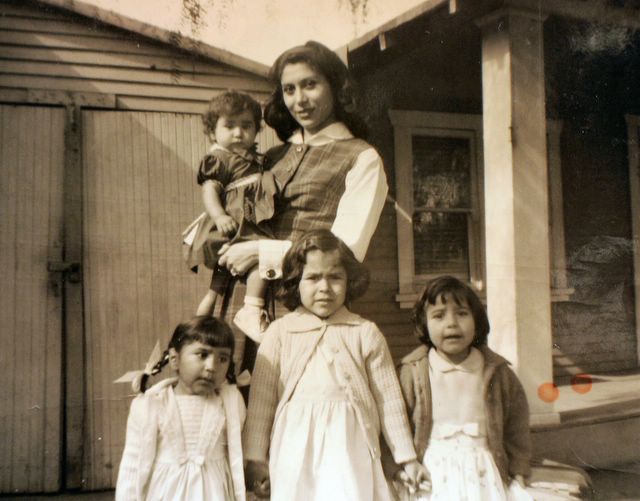
Thursday, March 17, 2005
Lunch with Mom
The kitchen’s sliding screen door sticks and I kick it so it will move the rest of the way. Mom’s Duarte townhouse smells of cigarettes, cut flowers, and whatever dish she’s cooking. She’s standing at the stove as I walk in, her right foot pointed outwards in a ballet-like pose, and she calls out, “Hi, mija,” as she stirs the menudo in the pot before her. Today’s lunch is store-bought. From the local supermarket. From a can. She’s always bought the same brand. Once on the table, she’ll squeeze lemon into the steaming bowls. She’ll sprinkle oregano into her palm and rub her palms together to further ground the dried oregano flakes, dropping the spice into the soup. She’ll shake chili pepper into the soup as well.
Then we’ll sit and eat.
We’ll turn the soap opera on. We've always watched soap operas, whether they're in Spanish or English.
But you must understand, the entire time, since I stepped foot into her kitchen, we’re talking. Talking about my work, about the dreams we had last night, about something my mother’s mother said. We’re talking about my brother and sister, about memories, about Papa. We’re talking about A and J who are my only children so far. We’re talking about them at their schools, about how I should have just picked up A from his preschool.
She takes care of A on the three days he’s not in preschool and she’s never gotten used to him being someplace else. She says, “How can you leave the light of my life there?”
We’ll eat and she’ll tell me what she’s planning for dinner and tries to get me to stay. “It’s going to be so good, mija!” I’m tempted because I love the way she makes chicken liver and onions – and she’s only making it as an enticement for me. The soap opera is so dumb we laugh until it hurts. After, I leave the lunch mess on the table because when I’m with her I’m lazy and childlike. Instead of cleaning, I reach into my bag and pull out something I’ve written and read it to her. She says I should record books for the blind. I nod like it’s really possible to do and she tells me about the latest romance novel she’s reading. We decide I could write those for a living.
“They’re so easy.”
“But I want to write like James Joyce.”
“My father was a writer,” she says. She never knew her father. My grandmother tells me he was an abusive bastard, but my mother always says my grandmother lies.
She gets up and I look at her. She’s round in the belly – her hair is colored a dark brown and it’s straight to her shoulders. She hardly has any lines on her face despite her being 61. I can tell she took a shower today because she has traces of make up on her cheeks. She’s got large breasts and they fill the simple tee-shirt she wears with yellow capris. Her toenails are polished…but she uses the word, painted.
We talk and talk. I call my husband and ask if he can pick up the boys from school and he agrees. My sister’s coming over with her little one. She hasn’t yet had kid number two or three. My mother talks about her old boyfriends in Mexico, about the dances she used to go to. I’ve heard the stories a million times. I can’t remember them anymore, not really.
I carry with me a vision of her as a young woman sitting at a table in a crowded room, the music loud. She’s smoking, drinking, and entertaining the long line of admirers, flashing those cat eyes of hers at them. The smoke of her cigarettes wafts around her face, up above her, drifting into the dim lights, and she smiles coquettishly, seductively. The men will do anything for her. She’s a movie star – she’s a model – she’s fabulous and beautiful and dramatic – she’s everything I’m not.
Her small house is filled with Mexican artwork – books, paintings, clothing, and music. Sometimes we sit on the floor of the kitchen and we sort through her cassettes and cd’s and listen to the music. She cries when hears some of it. I know she misses Mexico. She’ll never go back. She makes salsa using a molcajete, something like a mortar and pestle made of volcanic rock. It’s ancient. She wears dresses with the delicate, colorful embroidery of Mexican artists. She cooks Mexican food with passion. Enchiladas, homemade tortillas, huevos rancheros. Many more. She tries it all.
She feeds us these foods, these dishes. Feeds my brother, my sister, myself. It’s her way of showing us she loves us, her way of telling us that she’s sorry for all those lost years.
With the children, with Papa gone, we’ve reached this strange place of peacefulness. Anger leaves when I’m in her kitchen. She’s perfect this way. She’s the friend I remember. The friend that often left and was replaced by someone tormented and consumed by alcohol and drugs and pain. She’s a wonderful grandmother. When my sister comes over, the bliss will continue. We’ll laugh and eat more. We’ll be happy that day. That day I have lunch with Mom.
Today, my house is bereft of Mexican art. For dinners, I cook salmon with lemon, baked ziti with ground beef and a touch of Italian sausage, or roast in a crock-pot. Spaghetti. I can’t speak Spanish worth a damn. I wear jeans and sweaters most of the time. I can’t use the molcajete. It sits next to my sink, holding lemons. My mother’s books are still in storage because we don’t have a place to put them. I do have her curio cabinet. Through the glass, I see a picture of her with me on my wedding day. It’s there next to the Aztec-style statuettes she used to keep in her window. There are days I mourn the loss of my culture.
When I close my eyes at night, when I'm drifting in between dreams and wakefulness, I hear her, her voice.
“Hi, mija.”
Then we’ll sit and eat.
We’ll turn the soap opera on. We've always watched soap operas, whether they're in Spanish or English.
But you must understand, the entire time, since I stepped foot into her kitchen, we’re talking. Talking about my work, about the dreams we had last night, about something my mother’s mother said. We’re talking about my brother and sister, about memories, about Papa. We’re talking about A and J who are my only children so far. We’re talking about them at their schools, about how I should have just picked up A from his preschool.
She takes care of A on the three days he’s not in preschool and she’s never gotten used to him being someplace else. She says, “How can you leave the light of my life there?”
We’ll eat and she’ll tell me what she’s planning for dinner and tries to get me to stay. “It’s going to be so good, mija!” I’m tempted because I love the way she makes chicken liver and onions – and she’s only making it as an enticement for me. The soap opera is so dumb we laugh until it hurts. After, I leave the lunch mess on the table because when I’m with her I’m lazy and childlike. Instead of cleaning, I reach into my bag and pull out something I’ve written and read it to her. She says I should record books for the blind. I nod like it’s really possible to do and she tells me about the latest romance novel she’s reading. We decide I could write those for a living.
“They’re so easy.”
“But I want to write like James Joyce.”
“My father was a writer,” she says. She never knew her father. My grandmother tells me he was an abusive bastard, but my mother always says my grandmother lies.
She gets up and I look at her. She’s round in the belly – her hair is colored a dark brown and it’s straight to her shoulders. She hardly has any lines on her face despite her being 61. I can tell she took a shower today because she has traces of make up on her cheeks. She’s got large breasts and they fill the simple tee-shirt she wears with yellow capris. Her toenails are polished…but she uses the word, painted.
We talk and talk. I call my husband and ask if he can pick up the boys from school and he agrees. My sister’s coming over with her little one. She hasn’t yet had kid number two or three. My mother talks about her old boyfriends in Mexico, about the dances she used to go to. I’ve heard the stories a million times. I can’t remember them anymore, not really.
I carry with me a vision of her as a young woman sitting at a table in a crowded room, the music loud. She’s smoking, drinking, and entertaining the long line of admirers, flashing those cat eyes of hers at them. The smoke of her cigarettes wafts around her face, up above her, drifting into the dim lights, and she smiles coquettishly, seductively. The men will do anything for her. She’s a movie star – she’s a model – she’s fabulous and beautiful and dramatic – she’s everything I’m not.
Her small house is filled with Mexican artwork – books, paintings, clothing, and music. Sometimes we sit on the floor of the kitchen and we sort through her cassettes and cd’s and listen to the music. She cries when hears some of it. I know she misses Mexico. She’ll never go back. She makes salsa using a molcajete, something like a mortar and pestle made of volcanic rock. It’s ancient. She wears dresses with the delicate, colorful embroidery of Mexican artists. She cooks Mexican food with passion. Enchiladas, homemade tortillas, huevos rancheros. Many more. She tries it all.
She feeds us these foods, these dishes. Feeds my brother, my sister, myself. It’s her way of showing us she loves us, her way of telling us that she’s sorry for all those lost years.
With the children, with Papa gone, we’ve reached this strange place of peacefulness. Anger leaves when I’m in her kitchen. She’s perfect this way. She’s the friend I remember. The friend that often left and was replaced by someone tormented and consumed by alcohol and drugs and pain. She’s a wonderful grandmother. When my sister comes over, the bliss will continue. We’ll laugh and eat more. We’ll be happy that day. That day I have lunch with Mom.
Today, my house is bereft of Mexican art. For dinners, I cook salmon with lemon, baked ziti with ground beef and a touch of Italian sausage, or roast in a crock-pot. Spaghetti. I can’t speak Spanish worth a damn. I wear jeans and sweaters most of the time. I can’t use the molcajete. It sits next to my sink, holding lemons. My mother’s books are still in storage because we don’t have a place to put them. I do have her curio cabinet. Through the glass, I see a picture of her with me on my wedding day. It’s there next to the Aztec-style statuettes she used to keep in her window. There are days I mourn the loss of my culture.
When I close my eyes at night, when I'm drifting in between dreams and wakefulness, I hear her, her voice.
“Hi, mija.”
Subscribe to:
Posts (Atom)